Part of the message unit Krasnij Bor, August 1942
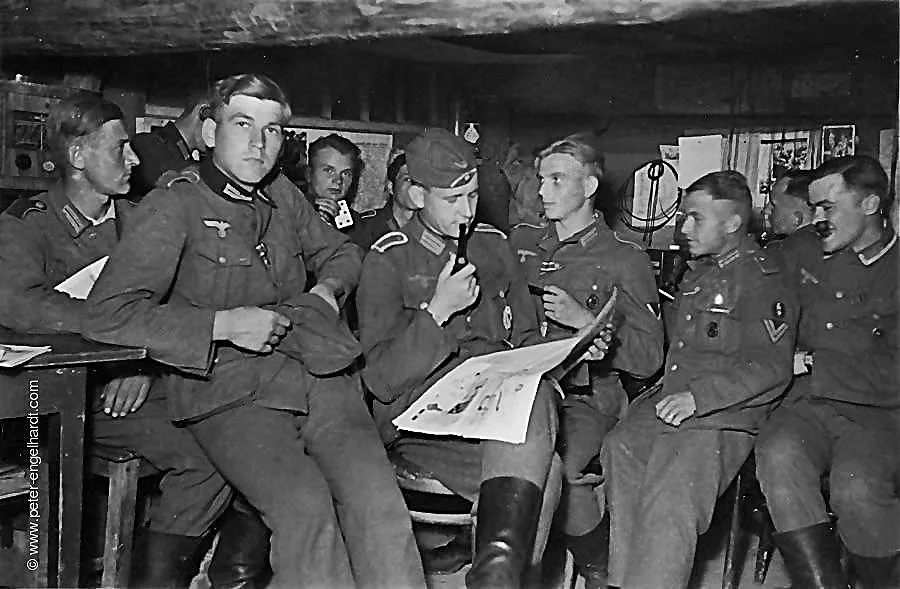
Here, one can see the interior of one of the troop bunkers—structures whose origins and construction methods are documented in several photographs from the Volkhov region.
A close look at the photograph suggests that this is actually a typical earthen dugout (or earth bunker), built using improvised methods and locally available materials.
The following visual clues support the conclusion that this is most likely such an earthen dugout:
The ceiling structure: The massive, dark beam running horizontally above the soldiers’ heads is a classic feature of an excavated dugout. It is clearly not a concrete wall, but a wooden structure supporting the earthen roof.
The wall lining: In the background, one can see dark surfaces (possibly wooden planks or stretched tent sheets) intended to prevent soil from trickling directly into the living area during rain or damp weather.
Lighting and cramped conditions: The lighting is rather dim and appears to come from a central source; this reflects the typical, low-ceilinged atmosphere of a dugout sunk into the ground—a design often chosen to enhance camouflage.
Furnishings: The presence of tables, chairs, and maps on the wall reveals an attempt to establish a semblance of bureaucratic or personal normality within this "hole"—typical of the prolonged periods of static warfare on the Eastern Front (such as at the Volkhov), where troops often had to settle into these earthen structures for months at a time.
Therefore, this dugout should not be confused with a bunker built to formal fortification specifications.
It was a practical solution: excavated, shored up with logs, and covered with earth and branches for concealment and protection against fire. Essentially, a habitable pit.If you say that you have documented the construction of such shelters in other photos, this image fits perfectly as an "interior view" of the process you describe there.
The visually distinct text was created in July 2026 with the help of the AI Gemini. - Page translated with Google.
© Peter Engelhardt, www.peter-engelhardt.com. All rights reserved.


