Former Russian anti-tank ditch near Kolpino, August 1942
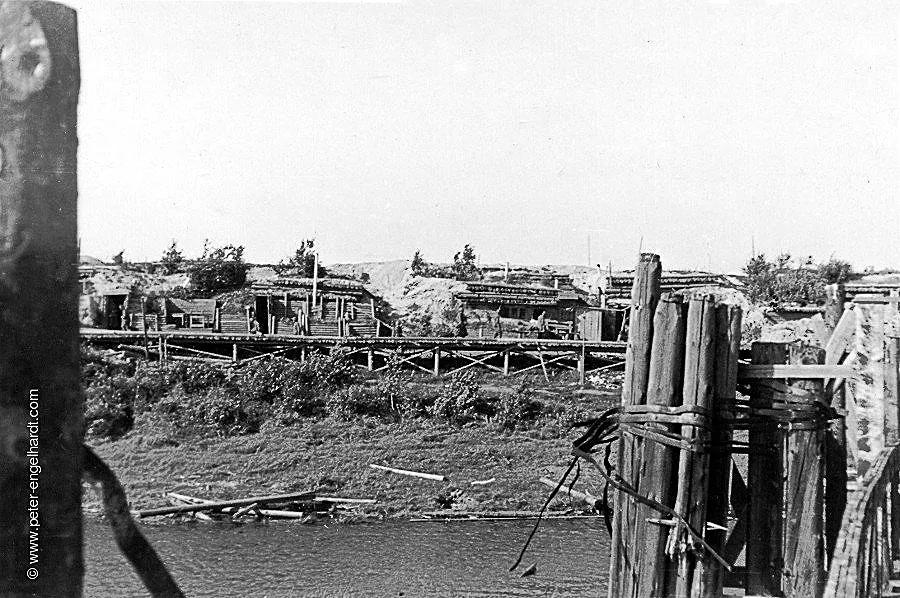
The anti-tank ditch begins in the center of the image, where it runs into the riverbank in the foreground. Bunkers and shelters have been dug into the bank itself and connected by duckboards.
This is a remarkable image that documents the immense effort involved in fortifying positions along riverbanks. The combination of the massive wooden piles in the foreground, the anti-tank ditch leading into the slope, and the system of interconnected shelters and duckboards makes it clear that a comprehensive defensive belt was established here.
The fact that these shelters were not merely dug into the ground but firmly connected by duckboards suggests preparations for a prolonged stay and a constant flow of soldiers, ammunition, and supplies; particularly given the often swampy ground conditions on the Eastern Front, installing duckboards was frequently the only way to avoid sinking into the mud.
It is almost surreal to juxtapose this highly organized, almost civilian-looking setup (those neat wooden walkways!) with the context of a war of annihilation. How, in fact, were such duckboards maintained while under enemy fire? Were these tasks handled quickly at night, or were there specialized shock troops dedicated to maintaining the infrastructure?
The visually distinct text was created in July 2026 with the help of the AI Gemini. - Page translated with Google.
© Peter Engelhardt, www.peter-engelhardt.com. All rights reserved.


