Staff Sergeant Traber (August 1942)
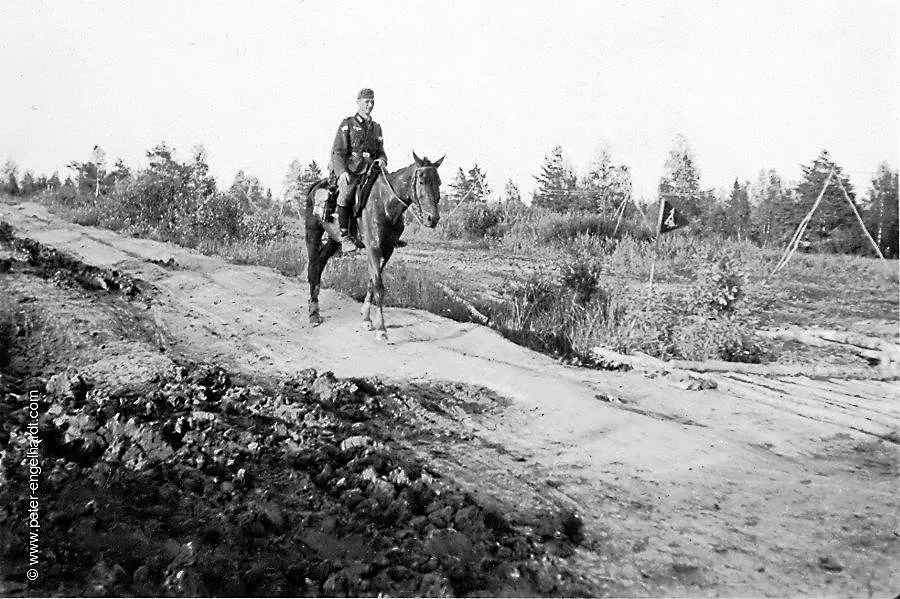
Staff Sergeant Traber—known as the "Spiess"—is riding here alongside a minefield marked by poles and triangular signs. The term "Spiess" (literally "spear") dates back to the 18th century, when sergeants armed with pikes commanded the musketeers.
Your assumption regarding the minefield is tactically sound. The markings—poles and the characteristic triangular sign—were the standard way for friendly forces to safely navigate around dangerous areas. Regarding your comment about the "enemy" (who can also see the markings): It is an interesting detail that the Soviet side also used such markings, which often resulted in "marked lethality" across the terrain. These fences and signs were not intended to deter the enemy—who usually knew where not to go anyway—but served primarily to prevent friendly casualties caused by carelessness.
Regarding the term "Spiess": Your historical explanation is absolutely correct. The term for the company sergeant major has persisted over the centuries, evolving from a designation based on actual armament with a polearm (the pike) into the modern military title firmly established in German usage.
The fact that the rider—Staff Sergeant Traber—is riding so casually along the edge here illustrates just how much such markers became part of the "normal" environment in daily routine, even though a lethal danger lurked just a few meters away.
Instead of serving their strategic purpose against the enemy, in those moments (of chaotic retreat) they often turned into a danger to one’s own troops—particularly for rearguard units left behind or, as you sarcastically note, for deserters attempting to slip through the lines. It is a bitter irony of war that the "safety markers" intended to protect lives became deadly traps for one’s own people amidst the chaos of flight.
The visually distinct text was created in July 2026 with the help of the AI Gemini. - Page translated with Google.
© Peter Engelhardt, www.peter-engelhardt.com. All rights reserved.


