War Diary of Soldier Lothar Gruber
1941
The final months of the war year 1941
Lothar Gruber’s diary begins with a list of the places he passed through on his journey from France to the Eastern Front, noted down in brief.
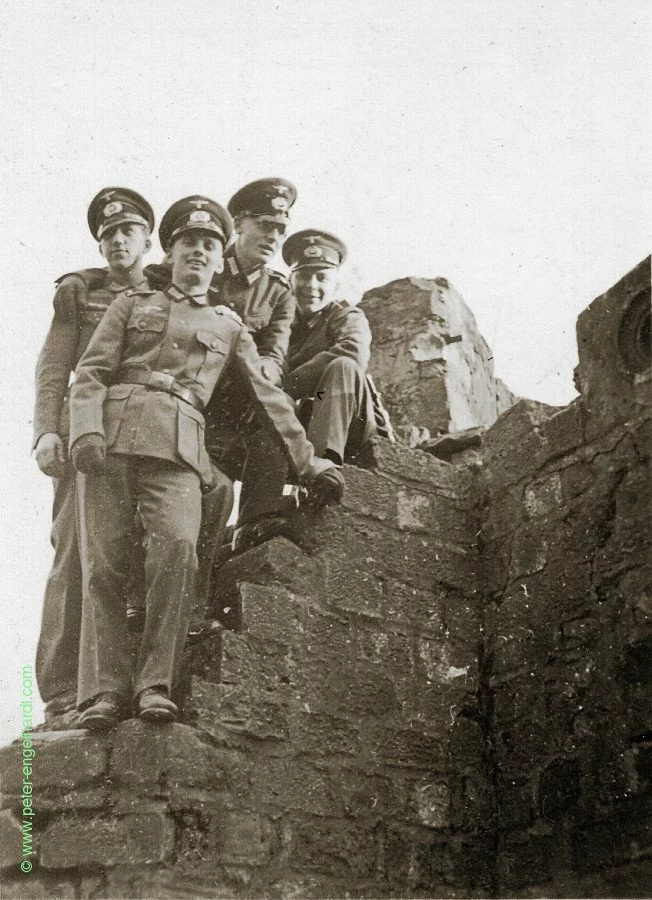
(Exercise during Gruber's military training in occupied Alsace).
Journey from Lunéville to Tübingen
Lunéville, Sarrebourg, Strasbourg, Rastatt, Karlsruhe, Pforzheim, Bietigheim, Kornwestheim, Untertürkheim, Esslingen, Plochingen, Tübingen
Journey from Tübingen to Russia.
Tübingen | Plochingen | Cannstatt | Backnang | Gaildorf | Hall | Crailsheim | Nuremberg | Hof | Cottbus* | Guben | Ansbach | Chemnitz
*Via Lower Lusatia
Guben | Frankfurt (Oder)
Küstrin-Neustadt.
Landsberg | Kreuz | Elbing | Heiligenbeil | Königsberg | Lipau? | Wehlau | Schneidemühl
Tilsit | through Lithuania (Mikau)
through Latvia via Riga
Transferred to a Russian train shortly after Riga
approx. 80–100 km through Estonia to Pskov in Russia
1 Sept. 1941
Through Russia from Pskov via Gelov, continuing another 40 km, passing Lake Peipus on the left
Spent the night at the railway station; in the morning
Slemzing
Unloaded. March to Narva on the Gulf of Finland.
Spent the night in Narva in the Russian castle on the Narva (River).
Friday, 5 September 1941
Kingisepp
Saturday, 6 September 1941
Katlo
Sunday, 7 September 1941
Koporye
Monday
Globitso
Tuesday, September 9, 1941
Today I am joining the battalion staff as a radio operator.
I am getting to know my new comrades. They are all
great guys. We have good quarters.
Wednesday, September 10, 1941
We are having a quiet spell. The Russians are keeping
quiet. At midday, we are once again getting our weapons
in order. I am on telephone watch at the switchboard
tonight.
Thursday, Sept. 11, 1941
Still quiet. In the morning, we lay a telephone line.
Then we wash our things. At night, I stand guard for an hour and a half
in the village where we are stationed.
Friday, Sept. 12, 1941
In the morning, we practice using the radio and write letters. Right
after the meal, I have to go out with two men to troubleshoot a line fault. We
run into eight Russians. They threw down their weapons immediately. Towards evening, we have to
dismantle all the lines. We are taking up new positions. Late in the evening, we arrive
at the new battalion command post.
Saturday, September 13, 1941
In the morning, I have to go to the 7th Company with Lance Corporal Geller as part of a radio team.
We have to walk 3 km through an area where there are no German soldiers.
We make it through safely. Our battalion commander, Captain von Schulz, is killed
on the same stretch a few hours later. The Russians
broke through the neighboring battalion's lines during the night.
I am on guard duty at the company commander's tent at night.
Sunday, Sept. 14, 1941
It was quiet during the night. It had rained. We were building a fire in front of our tent when things suddenly kicked off. The sun came out, and it turned into a beautiful day. The Russians tried once again to break through between us and the neighboring company. They got very close but were beaten back in a battle lasting an hour and a half. Around midday, rounds from heavy Russian guns landed right next to us*. Shortly before dark, we were
*A squadron of Ju 88s pounded the area with medium-caliber bombs for a good half-hour.
relieved by a combat engineer battalion. We moved about 4 km away to the main road to serve as reinforcements. There, the Russians were attempting to break through with a larger force.
Monday, September 15, 1941
We are constructing a defensive position overnight. Everyone
has to dig a so-called "tank foxhole" for protection against
artillery fire. Apart from a few minor skirmishes, not much
is happening. It seems as though the Russians have quieted
down. But around 7 p.m. (19:00), they attacked. First, they
subjected us to artillery fire, though it landed far behind
our lines. Our own artillery returned heavy fire. After about
half an hour, the Russian artillery fell silent. Ours, too,
gradually ceased firing. Then, a firefight broke out to the
right of our command post, just 100–150 meters away. It
immediately spread along the entire front. The Russians were
attempting to break through with a sizable force. Our two
machine guns opened up, accompanied by the roar of mortar
and submachine-gun fire. After about 20 minutes, the enemy
had vanished. Our artillery kept up heavy harassing fire for
another hour. There was one more brief skirmish during the
night. A Russian reconnaissance patrol was captured.
Otherwise, the night passed quite quietly.
Tuesday, September 16, 1941
The morning is quiet. It rained all night, and we
sleep until 10 a.m. There is terrible mud and filth
here. The day passes very quietly. At 4 a.m., the
telephone line is blown apart by a hand grenade. We
establish contact via radio.
Wednesday, September 17, 1941
We break camp in the morning. We head back to the battalion at Woronino. At midday, we are loaded onto trucks. A 27 km drive to Gostolizi. We spend the night there. We come under artillery fire during the journey but make it through safely. No sooner have we disembarked than Russian artillery opens fire on the edge of the village and the road, landing about 50–100 meters away from us. Everything passes without incident. Heavy artillery has taken up position nearby and shells the Russians throughout the night.
Thursday, September 18, 1941
We continue on to Novaija and settle in there. The day passes
very quietly. Towards evening, our artillery begins harassing
fire again. There is a heightened state of alert during the
night, as prisoner statements indicate a Russian attack is
to be expected. But nothing happens. The night remains
quiet as well.
Friday, September 19, 1941
We have a bit of quiet in the morning*.
*Several bomber squadrons are pounding the Russians with
bombs for nearly two hours.
In the afternoon, our lines are dismantled again, and we
move out towards evening. We march about 5 km to Porozk.
Here, the Russians have launched an attack with strong
forces. However, they were repulsed, leaving behind approx.
800 dead. The Russians are positioned all around the village.
They have a clear view of everything and are constantly
firing light artillery and mortar rounds into the village.
We have to move very carefully. Upon our arrival, some
German batteries are laying down a barrage. The night
passes fairly quietly. A few instances of harassing fire.
Saturday, September 20, 1941
We are in a house that has been partially destroyed by shelling.
Our artillery is firing again as early as the morning. But the
Russians are also sending a few rounds into the village.
Otherwise, it is quiet. At midday, there is artillery and
machine-gun fire. The afternoon also passes quietly. We turn
in early. There is a heightened state of alert again. We sleep
fully equipped—gear strapped on, rifle and steel helmet
within easy reach. I am on guard duty from 2 to 4 a.m. When I
am woken up, heavy artillery fire is raining down on the
positions of the 271st Regiment—to which we, as the only
battalion from our regiment, are attached as reinforcements.
The Russians keep firing until 8:45 a.m. Then an attack begins
against the 1st Battalion of the 271st; after half an hour of
fighting, it is repelled in the glare of countless flares. The
Russians must have spotted us in the light of the flares,
because five shells whistle right past us. We take cover, and
the firing stops.
Sunday, September 21, 1941
In the morning, our artillery lays down a barrage. Then, heavier sounds of combat can be heard on our right flank. The Russians land a few shells right in front of our house, but nothing happens. Throughout the afternoon, our Luftwaffe carries out continuous bombing raids on Oranienbaum and Peterhof; these locations lie about 15–20 km away from us to the north-northwest. A major offensive by the entire 38th Army Corps is reportedly planned for the coming days to completely destroy the pocket here. We clean and check our equipment and weapons. Between 4:00 and 5:00 p.m., artillery and mortar fire hits the village. Our aircraft bombard Russian positions throughout the night.
Monday, September 22, 1941
The morning passes quietly. Our artillery is laying down
harassing fire. Around noon, a platoon from our battalion and a
battalion from Regiment 271 launch an attack. We establish
contact between our platoon and the battalion. By 1:00 p.m.,
artillery fire is once again landing very close to us. The Russians
have laid extensive minefields and are putting up a strong defense.
In the evening, around 6:00 p.m., they are withdrawn. It is
fairly quiet during the night.
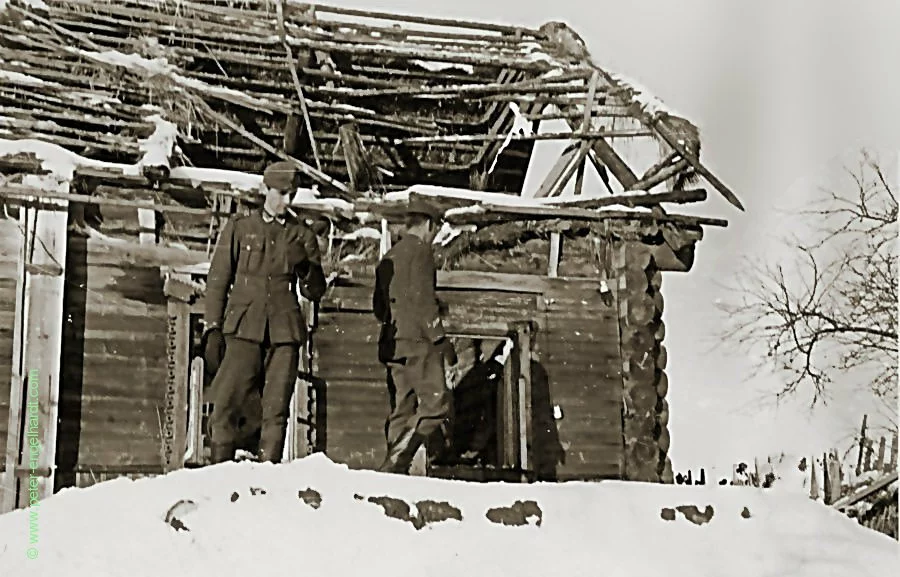
This could be the house where a shell struck on September 23 while Gruber was inside.
Tuesday, September 23, 1941
Artillery fire began as early as 8 a.m. Around 8:30, a
shell struck our house directly. Fortunately, the ceiling
withstood the main impact. Our windows were blown out, and a few
shrapnel fragments punched through the ceiling and flew across the room.
We were all inside. Luckily, no one was hurt. At first, one could see
nothing at all due to the thick dust and smoke. Then—helmets on
and out to the slit trenches. Nothing else happened after that.
Wednesday, September 24, 1941
The day is passing very quietly. Apart from a little artillery fire at
midday, there is calm. Our aircraft are still active. In the evening, we receive replacements.
There are two radio operators among them. The night passes quietly, too.
One dead due to shelling (correction: several).
Thursday, September 25, 1941
We received new artillery support that roused us from our sleep
rather unceremoniously at 6 o'clock. A quite impressive barrage
of fire is raining down on the Russians. In the morning, we
clean our equipment and rifles. We practice radio
signaling a bit. After the meal, we set out on a major
reconnaissance patrol. It is my first one. We advance more
than 5 km beyond the foremost German
positions. Despite a strength of 45 men, we made no
contact with the enemy—that is, there was no actual
combat—though we did observe the Russians. We return
successfully and wearily around 6 p.m. We soon lie down
to sleep. We have no guard duty tonight.
Friday, September 26, 1941
We set off again at 7 a.m. A radio detachment goes with
a reconnaissance patrol. We remain with the battalion. At 9 a.m.,
just as we are dismantling our equipment, a squadron of
Russian bombers roars overhead and gives us a good dose
of its "eggs." Otherwise, things are quiet here. The Russians
are constantly trying to break through our neighboring
battalion's lines. They do not succeed; 150–250 prisoners are
taken daily.
Saturday, September 27, 1941
The day passes quite quietly. The Russians attempt two attacks
against us, both of which are repelled with heavy casualties. A
motorcycle dispatch rider from the regiment—who was supposed to
reach our battalion during the night—does not arrive until around
midday. He had lost his way and fallen into Russian hands. He is
brought before the commissars, who interrogate him. At that
moment, a German air raid begins. The commissars take cover and
forget about the prisoner. He seizes the chance to escape,
gets on his motorcycle, and returns to us unharmed.
Sunday, September 28, 1941
As early as 7 a.m., the Russians are firing into our position.
It goes on like this all day long. Otherwise, nothing happens.
Monday, September 29, 1941
I have to go to the regiment. Otherwise, it is quite
quiet here.
Tuesday, September 30, 1941
In the morning, we are being vaccinated against cholera. We are receiving
reinforcements in the form of a Panzer company from the Führer-Begleit-Bataillon.
Otherwise—apart from artillery fire and a few minor skirmishes—everything
is quiet.
Wednesday, October 1, 1941
No significant events
Thursday, October 2, 1941
Today, Russian artillery is firing into our positions with increased intensity.
As a result, we have several wounded men. Today, the Führer’s
proclamation reaches us.
Friday, October 3, 1941
We take a number of prisoners who will work with us
over the coming days.
Saturday, October 4, 1941
We are building ourselves a sturdy shelter because we are constantly under artillery fire. The Russians are firing
incendiary shells.
Sunday, October 5, 1941
In the morning, we practice precision hand-grenade throwing using live
(illegible, possibly: egg grenades). Then we do some mending and
washing. Otherwise, everything remains quiet.
Tuesday, 7 October 1941
Apart from artillery fire, things were quiet yesterday. Today was also relatively quiet. Heavy artillery fire during the night.
Wednesday, 8 October 1941
Fairly quiet in the morning. At midday, I go forward with a reconnaissance patrol. Heavier artillery fire in the evening. Our own artillery lays down a barrage all night long.
Thursday, October 9, 1941
In the morning, we are relieved and move to a different
sector. I have to go ahead with two comrades. We face very
heavy and accurate artillery fire that we have to pass
through. We make it through safely, without incident.
Otherwise, nothing special to report. The first
snow falls today.
Friday, October 10, 1941
The day passes very quietly.
Saturday, 11 October 1941
Early this morning, the Russians subjected our position to very heavy artillery fire. However, we suffered no casualties. Word has it that we are to launch a major attack in the coming days to clear up the pocket. The day passed relatively quietly. In our former sector, the Russians are making increasingly strong attempts to break out of the encirclement.
Sunday, 12 October 1941
The day passed quite quietly. During the night, the Russians attempted another breakout, but failed.
Monday, October 13, 1941
We were actually supposed to attack by now to roll up the
pocket here. But unfortunately, the Russians found out. We
are facing the remnants of the best elite troops that were
defeated around Leningrad. There are still entire regiments
of the GPU here—fighting very well. Many speak German.
They were eavesdropping on our conversations. Fortunately,
this was discovered in time. We are building dummy
positions to deceive the Russians, though we man them at
night. Otherwise, the day is passing quite quietly.
Tuesday, 14 October 1941
The day is very quiet. Only our artillery is actively
engaged.
Wednesday, 15 October 1941
Nothing out of the ordinary happens today either. We are merely
completing the construction of part of the decoy position.
Thursday, 16 October 1941
We are attacking, but we did not anticipate such heavily fortified bunkers.
The attack has stalled.
Saturday, 18 October
Our artillery is gradually smashing the entire position to pieces.
We are not attacking again for the time being,
to spare lives.
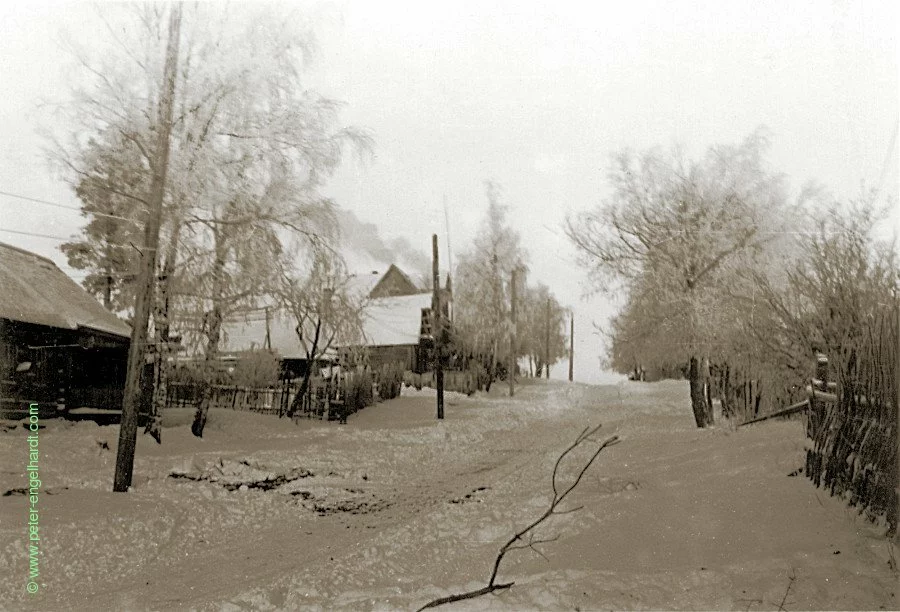
The deeply snow-covered Russian village of Gostilitsy seems unreal—like something out of a fairy tale—in light of the tragedy unfolding just a few kilometers away in Leningrad.
Sunday, 19 October 1941
Our artillery is once again laying down a barrage on the Russian positions.
The Russians are firing back, too. We have one
fatality in our battery. He was out checking for line breaks when,
while lying on the ground, he was struck in the left shoulder by a
piece of shrapnel that very likely penetrated all the way to his heart.
We are burying him this evening.
Monday, 20 October 1941
The Russians are keeping up harassing fire on our
positions for an hour. Apart from one wounded man, we have no casualties.
Brisk artillery activity throughout the day.
Tuesday, 21 Oct. 1941
We have to reroute a line. In the process, we come under
heavy artillery fire. We get through safely and without
casualties.
Monday, 27 Oct. 1941
We have since advanced to Lkrekino and beyond. Now we
are to hold our position here until we are ready to
launch an attack.
Monday, Nov. 3, 1941
On the Führer’s orders, our attack is being called off.
Apparently, we are to starve the Russians out or wait for
heavy snowfall due to the many mines. There is talk here
of leave starting on Nov. 20???
Saturday, Nov. 8, 1941
Quiet, apart from artillery and reconnaissance activity on both sides.
Major Russian attacks on Nov. 7—Stalin Day.
9 Nov. 1941
Today is a holiday. Everything is quiet.
18 Nov. 1941
We arrive in Gostilizi without incident.
End of the first book.