Lothar Gruber: Surviving Photographs and Field Post from 1940–1944
My dear, just imagine for a moment that the war is over.
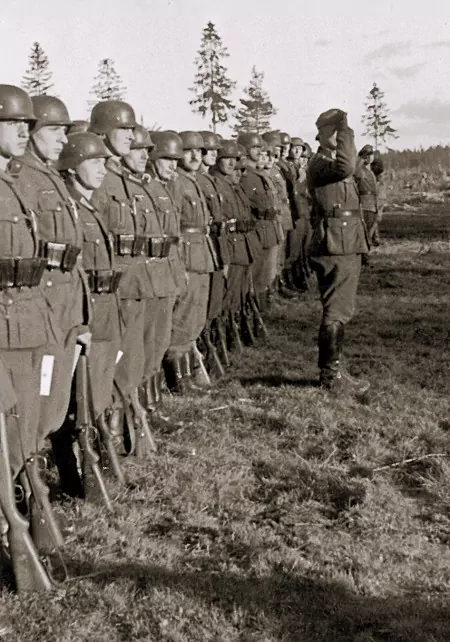
On September 6, 1944, Non-Commissioned Officer Lothar Gruber—originally from Stuttgart-Zuffenhausen—was killed in action in Mitau, Latvia, at the age of 22. According to the official death notification, his body had to be "left to the enemy."
From September 9, 1941, Gruber served in the 1st Battalion of the 272nd Regiment, part of the 93rd Infantry Division.
Thus, for a total of three years—albeit with interruptions for an NCO training course and a few periods of leave from the front—Gruber served in the Wehrmacht of the Third Reich as a so-called "Landser." In the soldier's jargon of the time, this term referred to an ordinary frontline soldier (etymologically: a shortened form of "Landsknecht"—originally a foot soldier armed with a lance).
Prior to his deployment on the Eastern Front, he served as an occupation soldier in France for an undetermined period—likely starting in the spring of 1941—during his military training.
Gruber left behind many photographs; fortunately, almost all the letters he wrote to his girlfriend (and future wife) have survived, as have his war diaries from 1941 and 1943.
The collection presented on this website (see the menu for diaries, field mail from 1942 to 1944, and photos from 1940 to 1944) features the war diaries alongside approximately 200 photographs and more than 300 letters.
The photographs taken as mementos of a great adventure very often show soldiers posing for the camera—either individually or in groups—or, without further explanation, nondescript landscapes.
Very few photographs depict actual combat scenes, though military equipment was frequently photographed.
Following the 1942 battles along the Volkhov, the Neva Salient, and in the Kholm sector, the photographs become scarcer in 1943, apparently ceasing altogether by early 1944.
Where available, the amateur photographs—in WebP and JPG formats—are labeled with their original captions. These captions served as the basis for the page titles and headings. The accompanying commentary was written by the author of this site.
The authentic photographs are, in themselves, harrowing documents; they bear little resemblance to the staged propaganda shots taken by war correspondents—images that continue to shape the visual perception of the past regarding all the warring parties of that era.
In addition to the photo collection, Gruber's field post letters and diaries are published here.
Only by viewing the photographs alongside the letters and surviving diaries does a vivid picture emerge of a Wehrmacht soldier during World War II—his dreams and longings, his worries and hardships, and his political worldview.
In addition to very personal matters, the field post letters contain accounts of the fighting involving Army Group North in the Leningrad and Kholm sectors, as well as in the Baltic states of Estonia and Latvia.
Nor are the rations, the films shown to the soldiers, or even the music from the Soldiers' Radio Belgrade left unmentioned. Such general information served as the criterion for the selection made; for the most part, these are excerpts, as reproducing the more intimate details of these letters would be not only uninteresting but also in poor taste.
Finally, the diaries describe events in terse terms; often, an entry consists of nothing more than "All quiet!" Occasionally, however, details emerge here that presumably could not be mentioned in field mail.
Thus, what remains of Soldier Gruber’s experiences—unfiltered by the changing times and political upheavals—is, thanks to his written and photographic legacy, far more than what millions of other victims of the Second World War were able to leave behind; it should serve as a warning to those of us who came after...
The website operator