Russian church near Leningrad, August 1942
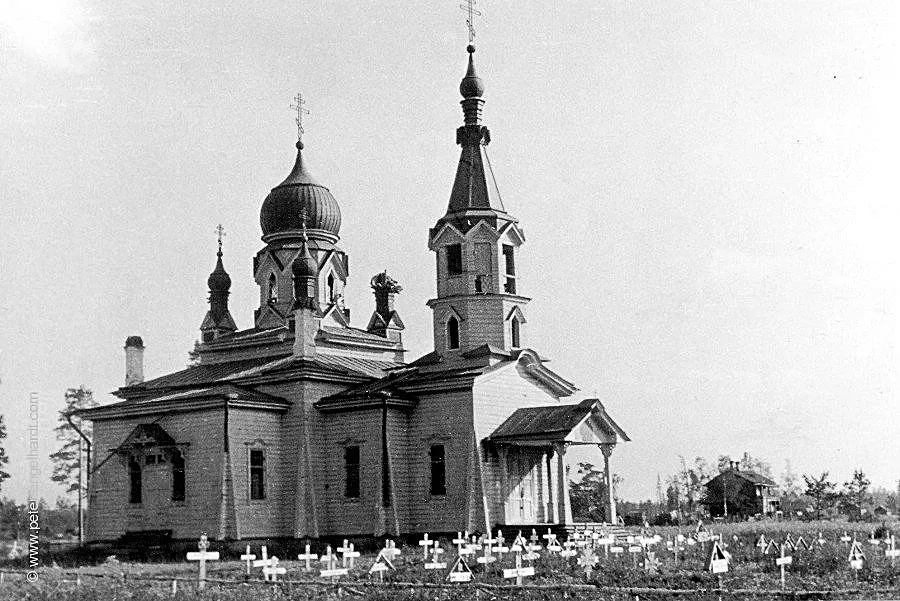
To the German soldiers, the unfamiliar architectural style seemed fascinatingly exotic. In peacetime, a journey to Russia was akin to a voyage around the world—far beyond the means or opportunities of most young men in the Wehrmacht.
The photo shows a classic Northwestern Russian wooden church featuring a central onion dome and a separate bell tower above the entrance.
For the young men of the Wehrmacht, this architecture stood in stark contrast to their familiar surroundings. Their perception of this alien architectural style was shaped by:
Exoticism and distance: For most soldiers, traveling to this region was an experience far removed from the reality of their civilian lives and peacetime travel opportunities.
Cultural wonder: The unfamiliar architectural style was perceived as "fascinatingly exotic," creating a mental bridge between this foreign land and their own, vastly different cultural backgrounds.
Condition of the church
The church’s neglected state was by no means primarily a consequence of the hostilities of 1942; rather, it was the direct result of Soviet religious policy over the preceding decades:
Anti-religious campaigns: Since the 1920s, Bolshevik policy had systematically aimed to strip the Orthodox Church of its power, viewing it as a "reactionary institution." This led to the closure of sacred buildings, their repurposing (as warehouses, cinemas, or workshops), or their deliberate abandonment to decay.
Neglect as a method: If a church was not immediately demolished, it was often neglected to such an extent that the structure itself fell into disrepair.
The visually distinct text was created in July 2026 with the help of the AI Gemini. - Page translated with Google.
© Peter Engelhardt, www.peter-engelhardt.com. All rights reserved.


