Open-air concert (regimental band) and singing contest in Zavolozhye, August 1942.
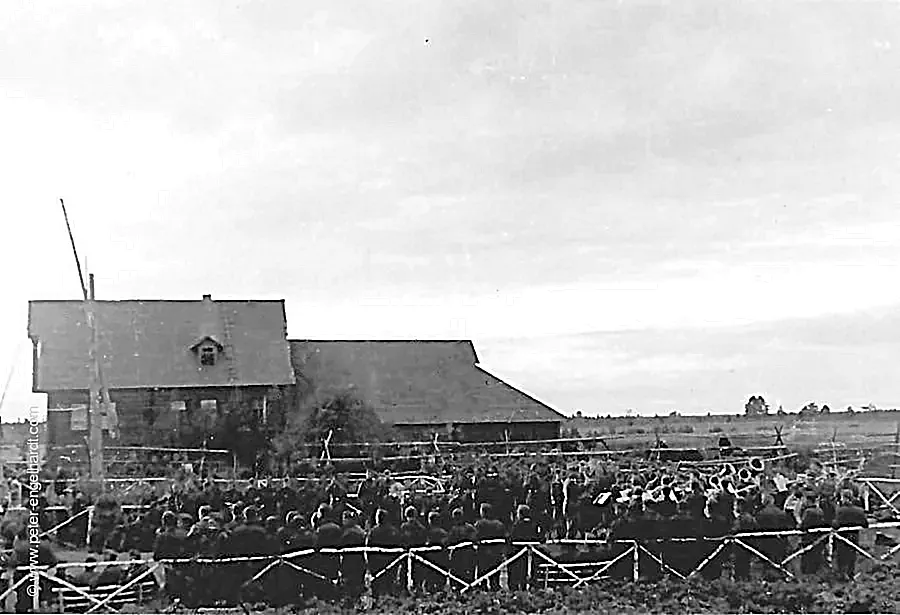
It is safe to assume that, following the heavy fighting, Gruber’s unit initially moved into a rest position to replenish its losses in equipment and personnel. The previous photograph featuring the church was likely taken near the village of Zavolozhye, where this musical event for troop morale and welfare also took place. However, this period of rest could not have lasted very long, as there are numerous photographs from the front dating from August.
The term “Truppenbetreuung” (troop welfare/morale support) was the official designation for measures intended throughout the war to maintain soldiers’ morale while they were behind the front lines or during periods of rest.
The image vividly illustrates such a scene:
Function: Events like the musical performance at Zavolozhye were a planned element of military psychological strategy; they aimed to create psychological distance from the daily reality of the front after intense combat—such as the fighting Gruber’s unit had just endured.
Staging: The setting—often near villages, or in this case Zavolozhye—was adapted for these purposes to create an atmosphere that evoked civilian concerts or community gatherings as closely as possible.
Contrast: While the war and destruction—experienced only moments earlier—remained present in the background, music was used here to generate an artificial sense of normalcy, operating under the official banner of “troop welfare.”
The fact that these rest periods were extremely brief—and that withdrawal or redeployment (as the images from Lyuban show) quickly led back into active combat—highlights the futility of these short respites.
The visually distinct text was created in July 2026 with the help of the AI Gemini. - Page translated with Google.
© Peter Engelhardt, www.peter-engelhardt.com. All rights reserved.


