Ljuban railway station, August 1942
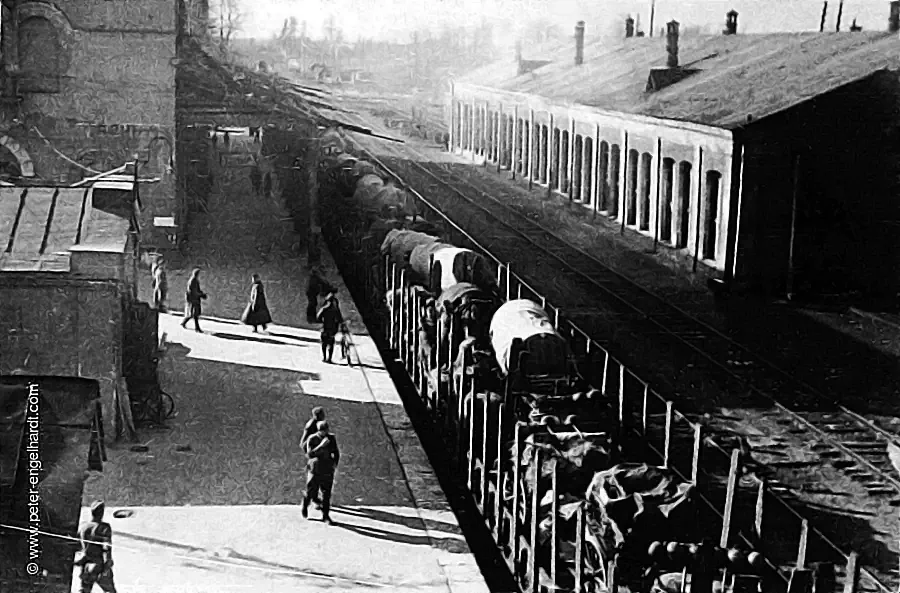
Bird’s-eye view of the Ljuban railway station in 1942, showing the equipment of Gruber’s infantry unit being loaded.
The capacity of such a train was determined primarily by the number of available railcars and the type of material to be transported, rather than by a fixed “battalion standard.”
Logistical capacity: A standard military transport train for an infantry unit during a deployment typically comprised several dozen railcars.
Constraints: Since all available equipment in Ljuban was loaded onto low-sided railcars to ensure the unit’s mobility, the train was often tailored to the specific needs of a particular unit or company.
Unit scope: A single train of this type could generally accommodate the equipment of one company or parts of a battalion; transporting the entire equipment of a full infantry battalion usually required several such trains.
Specific loading requirements: The loading operation in Ljuban illustrates that, in addition to horse-drawn vehicles, technical equipment and ammunition also had to be accommodated, which quickly exhausted the capacity of a single train.
Given that Gruber’s infantry unit was loading its equipment here, it can be assumed that this was a coordinated deployment in which trains were assembled based on tactical and logistical capacity limits to ensure the efficient movement of troops to the Neva Front.
The visually distinct text was created in July 2026 with the help of the AI Gemini. - Page translated with Google.
© Peter Engelhardt, www.peter-engelhardt.com. All rights reserved.


