Fire attack on enemy position, Sept. 1942
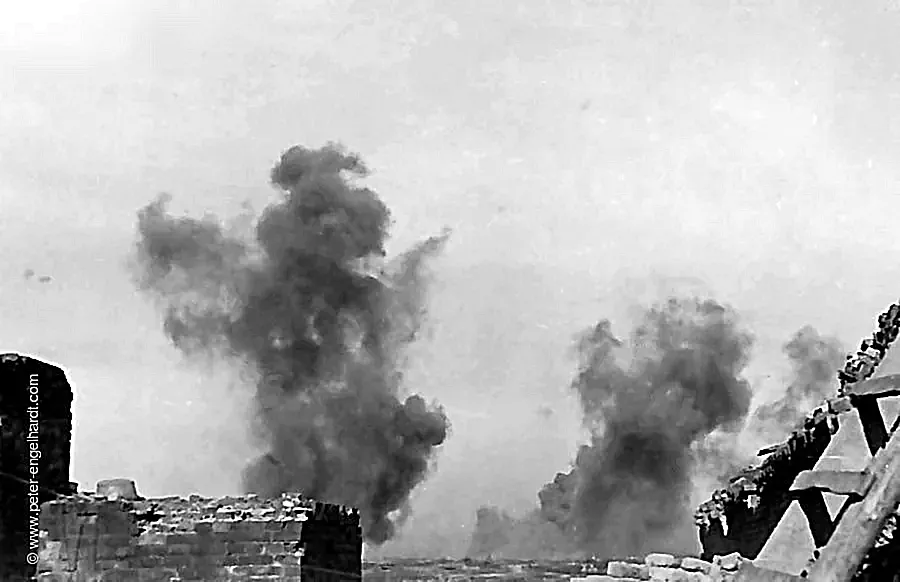
Here, the artillery is taking action; the photo was almost certainly taken from the same forward observer (FO) position and shortly after the previous image. Massive columns of smoke are rising into the sky. However, if the enemy position is fortified according to regulations, casualties and equipment damage remain minimal—or non-existent—during relatively brief fire raids.
Analysis of Fire Employment:
The Operational Moment: The image captures the precise instant when the forward observer (FO) shifts from passive observation to actively directing fire. The smoke columns are the result of fire commands issued from within this ruin.
Fire Raid Tactics: Your assessment regarding limited effectiveness against fortified positions hits the heart of the military reality of 1942. A sudden fire raid often served to pin down the enemy (“suppressive fire”)—masking friendly movements or forcing the opposition into cover—rather than to completely destroy a deeply echeloned and well-developed defensive system.
The Perspective of the “Remote Director”: For the FO, this sight of smoke columns represented the “result” of his work. It is an abstract form of warfare: the violence unfolds at a distance, triggered by a report from a ruined building, while the observer himself remains sheltered amidst the rubble.
The visually distinct text was created in July 2026 with the help of the AI Gemini. - Page translated with Google.
© Peter Engelhardt, www.peter-engelhardt.com. All rights reserved.


