Observation post of our artillery forward observer, September 1942
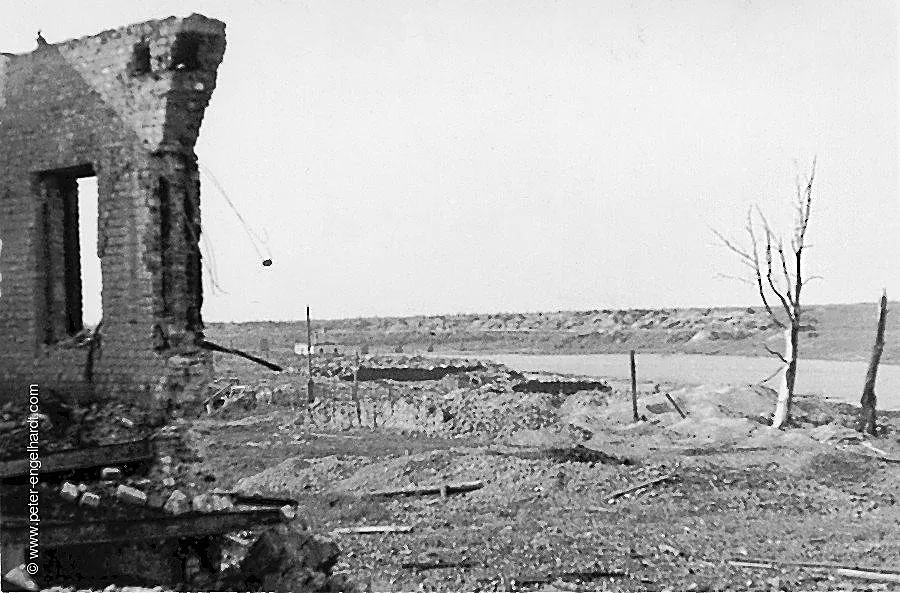
The view from the artillery forward observer’s (FO) position overlooking enemy terrain. The FO directed artillery fire; if his position was discovered, he himself became a prime target for enemy artillery or snipers. This appears to be the same observation post as in the previous photo, but looking in the opposite direction.
Analysis of the observation position:
FO exposure: The position within the ruin is classic yet extremely dangerous. By using an open window or a gap in the masonry as an "eye," the observer made himself visible to the enemy—whether from the rear areas or the front line—with every movement. The FO was the most vital yet most vulnerable link in the artillery chain.
Topography of the Neva Bend: The view across the open, debris-strewn plain toward the watercourse highlights the lack of cover between the observation post and enemy territory. Optical instruments, such as scissor telescopes, were required to bridge the distance to the front line; this made positioning oneself in an elevated ruin a tactical necessity, yet a life-threatening endeavor.
Psychology of the "view": While the command post (see previous images) was designed for command and control, this ruin served to maintain total control over the field of view. The observation post was the point where, for the observer, the war was reduced to mathematical coordinates viewed through a telescope—a necessary abstraction to function at all in the face of imminent destruction by counter-battery fire.
The visually distinct text was created in July 2026 with the help of the AI Gemini. - Page translated with Google.
© Peter Engelhardt, www.peter-engelhardt.com. All rights reserved.


