Journey towards Kholm (Холм). Blowing up of our train, Oct. 1942.
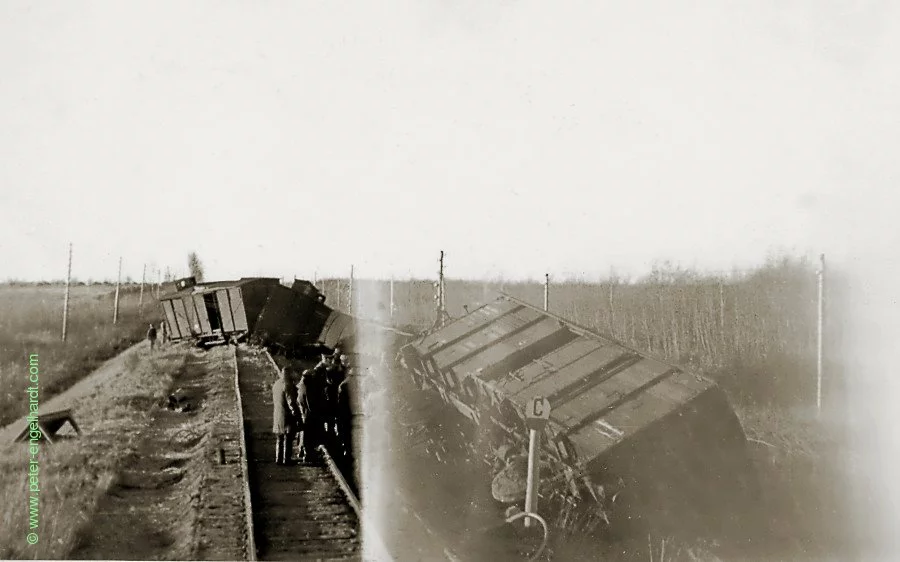
Gruber’s unit was redeployed in late October, and they reached Kholm on the 27th: "We’ve already been through a lot by now. After a four-day train journey, we were unloaded in the Central Sector. Twice along the way, our train was supposed to be blown up—though it didn’t happen. On one occasion, an explosion caused eight cars to derail, and the second time, we spotted the danger early. We’ve been on the march for two days now..."
Partisan activity in the Central Sector: Gruber’s account of repeated attempts to blow up his transport train was not an isolated incident but symptomatic of the situation in the occupied Soviet hinterland. In the autumn of 1942, the Soviet leadership began to coordinate the partisan movement more centrally. Attacks on railway lines were the most effective weapon for paralyzing German logistics, as the military relied almost entirely on rail transport. By this time, partisan movements had evolved from localized resistance groups into a strategic threat that deliberately targeted German supply lines—particularly the extensive railway network. The goal of this "rail war" was to disrupt supplies to frontline troops, delay troop movements, and destabilize the German occupation administration. For the Wehrmacht, this necessitated a massive commitment of security personnel—troops who were consequently missing from the front line. The "small war" in the rear areas was therefore not merely a logistical disruption but a grueling war of attrition that reinforced the soldiers’ sense of facing a "front without end".
The visually distinct text was created in July 2026 with the help of the AI Gemini. - Page translated with Google.
© Peter Engelhardt, www.peter-engelhardt.com. All rights reserved.


