View of the battalion command post from the observation point, September 1942
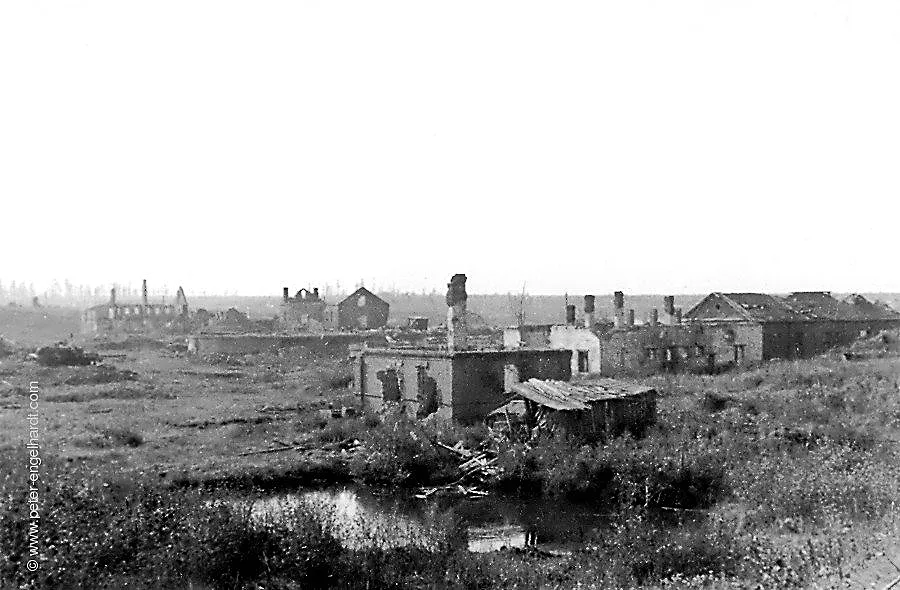
Here, the battalion command post is located in a ruined village. It is unclear whether the village shown here fell victim to combat operations or was destroyed by the Russians to deny the Wehrmacht the opportunity to establish a foothold there. In November 1941, Stavka Order No. 0428—for which Stalin bore responsibility—was issued: "Completely destroy and burn down all settlements in the rear of German troops, at a depth of 40 to 60 kilometers from the main battle line and 20 to 30 kilometers to the left and right of the roads." This was akin to Hitler’s "Nero" Order issued at the end of the war.
However, on an even larger scale, the Wehrmacht destroyed thousands of villages and towns in the Soviet Union starting with its retreat in 1943, implementing the "ARLZ measures" (dispersal, evacuation, incapacitation, and destruction) ordered by Hitler; these actions were accompanied by the mass deportation of civilians. In a field post letter dated July 21, 1944 (Letter No. 297), Gruber briefly describes such an apocalyptic situation, noting that fires were burning everywhere along his line of retreat.
Analysis of the destruction of settlement infrastructure:
Strategy of denial: Stavka Order No. 0428 marks an extreme point in total war: the deliberate acceptance of homelessness for one’s own population in order to deny the enemy living space. The image illustrates this tactic, in which the village is reduced to a mere tactical backdrop devoid of any civilian function.
Symmetry of Ruin: Contrasting this with the Wehrmacht’s later ARLZ measures highlights the principle of total destruction—a practice that became increasingly radicalized over the course of the war on the Eastern Front. It represents a spiral in which military necessity led to the obliteration of entire cultural landscapes.
The Observer’s Perspective: Gruber’s brief yet evocative description of the burning horizon during the retreat bears witness to the fact that, for the soldier on the ground, this "apocalyptic situation" was no longer an abstract political directive, but a tangible, apocalyptic reality.
The visually distinct text was created in July 2026 with the help of the AI Gemini. - Page translated with Google.
© Peter Engelhardt, www.peter-engelhardt.com. All rights reserved.


