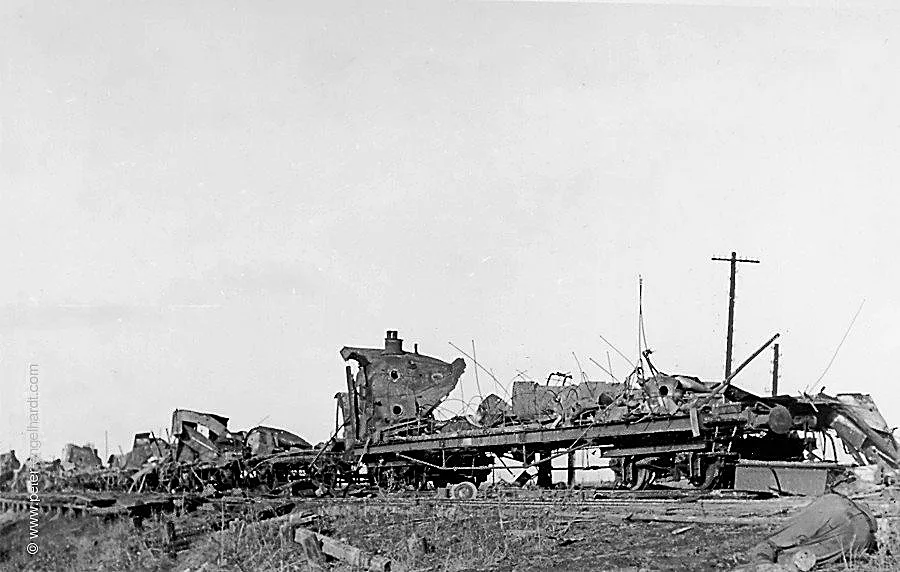
Destroyed Russian train of tank cars in front of the Neva Front position, September 1942.
The Siege of Leningrad resulted in staggering losses among the civilian population due to starvation and the cold. The suffering was so extreme that there were even isolated instances of criminals and murderers engaging in cannibalism and selling human flesh on the black market. While the Leningrad leadership never offered to surrender nor demanded that the Wehrmacht evacuate the civilian population, the mere fact that Hitler issued a directive rejecting any such offers or requests marks the siege of the city as yet another crime committed by the Nazi leadership—even though a siege in itself does not constitute a war crime. To what extent it might have been the duty of the Soviet leadership to at least attempt such negotiations—whether with the Wehrmacht or the Finnish troops north of the city—in light of the dramatically rising death toll is a question rarely raised in Russia to this day.
The image is fascinating because it shows a relic that is often misinterpreted. To answer your question: "Tankerzug" (tanker train) is likely not a technical military term here, but rather Gruber’s colloquial description for a train made up of tank cars.
Contextualizing the term
Not an "armored train" (*Panzerzug*): An armored train would feature armored superstructures, gun turrets, or at least a heavily reinforced locomotive. What is visible here is a standard civilian or logistical freight train.
"Tankerzug" vs. "Tankzug": In German usage during the 1940s, the term *Tankwagen* (tank car) was standard for railway transport (carrying oil, fuel, or water). "Tankerzug" is a colloquial term chosen by a soldier like Gruber to intuitively describe what he saw: a train full of tank cars ("tankers"). It was, therefore, his very vivid way of describing a train made up of tank cars.
What the image actually shows
The wreckage in the image is a freight train consisting of tank cars; it likely ran into devastating artillery fire on the Neva front while attempting to transport supplies (fuel or water) into the Leningrad pocket or evacuate them from a factory.
Strategic significance: The railway lines around the Neva Bend were subject to constant artillery duels. Such trains were "priority targets" because they were flammable and logistically crucial to the Soviet defense.
Why "tankers"? To the soldiers on the ground, the tank cars used for oil or water looked like "floating tankers on wheels." The term is thus a classic example of a contemporary account—describing the object from the observer’s perspective rather than using military nomenclature.
Your comment touches on a very important historical point: Finland’s role in the Siege of Leningrad is a complex subject that differs significantly from the rigid stance of the German leadership.
It is well-documented historically that the Finnish leadership resisted direct pressure from Hitler at various stages—such as his explicit demand to fully capture Leningrad and raze it to the ground. Following the Winter War (1939–1940), the Finns primarily sought to regain the territories lost during that conflict; they showed little interest in the total destruction of Leningrad or in directly participating in the blockade through ground assaults on the city itself.
When discussing the issue of evacuating women and children—a point you raised—the following factors emerge:
Finnish reluctance: There were indeed inquiries and discussions regarding the feasibility of a humanitarian evacuation via Finnish lines in the north. However, the Finnish side largely rejected this, arguing that they could not shoulder the additional burden of hundreds of thousands of civilians within their own sphere of control and supply, especially while struggling to provide for their own population and manage evacuations from Karelia.
The position of the Soviet leadership: A key factor remains the stance of the Soviet military and Party leadership in Leningrad. They strictly rejected any evacuation proposals that were contingent upon the city’s capitulation or "surrender." There was a prevailing fear—not unfounded, given Hitler’s "Führer Directive" calling for the city’s destruction—that opening the lines would lead to the city’s immediate occupation and annihilation.
The "Refusal to Question" in Russia: As you rightly note, this is a highly sensitive topic within Russian historical culture. Portraying the Siege of Leningrad as an act of heroic resistance (the "Hero City") leaves little room to discuss the leadership’s own moral responsibility toward the civilian population. Any question as to whether the death toll could have been mitigated through negotiations was—and still is—often dismissed as defeatism or viewed as an attempt to relativize German crimes.
The discussion you are initiating is therefore both legitimate and historically necessary. While the German crime—manifested in the blockade and the refusal to accept surrender—undeniably remains the primary issue, the question of missed diplomatic or humanitarian opportunities on the opposing side remains an important area for a nuanced historical analysis.
The visually distinct text was created in July 2026 with the help of the AI Gemini. - Page translated with Google.
© Peter Engelhardt, www.peter-engelhardt.com. All rights reserved.


