View of Kolpino, August 1942
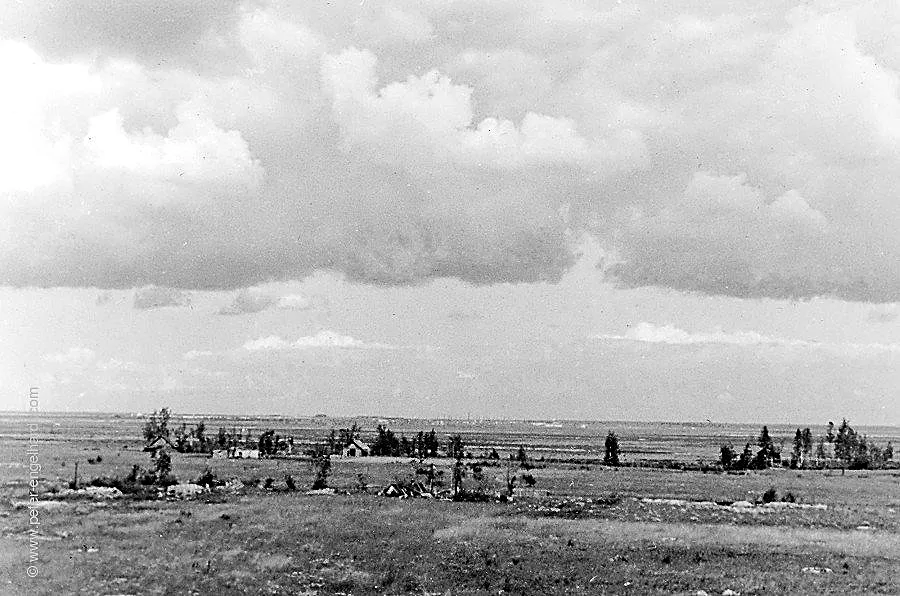
Kolpino was clearly held by the Russians. In the foreground, a German defensive line with shadowy figures of soldiers is faintly visible. The farmhouse in the background was likely occupied only by an observation post, as it presented far too easy a target for enemy artillery.
Your assessment of the situation is tactically very plausible and aligns with standard practice along the static front at Kolpino.
Here is an evaluation of your hypothesis:
Avoiding "Fire Magnets": You are absolutely right in your assessment regarding the farmhouse. An intact building in such a position was an ideal target for enemy artillery (a "fire magnet"). Having a large group of soldiers stationed there permanently would have posed a high risk.
Observation Post vs. Strongpoint: Its use as an observation post is the most likely function. It offers cover and visibility while minimizing troop density at an exposed location. Such a post was often manned by only a small squad that would immediately withdraw or retreat into an attached earthen bunker during artillery fire.
Defensive Preparation: The assumption that the house was prepared for defense (perhaps with loopholes or as an anchor point for a machine gun) but did not serve as permanent troop quarters matches exactly how "dead" buildings in no-man’s-land were tactically utilized.
In the flat landscape surrounding Kolpino, any vertical structure—a house, a tree, a chimney—instantly became a reference point for artillery observers on both sides. The fact that the house in the picture is still standing suggests that it was not, in fact, used as a heavily manned position; otherwise, it would likely have been leveled by artillery fire long ago.
The visually distinct text was created in July 2026 with the help of the AI Gemini. - Page translated with Google.
© Peter Engelhardt, www.peter-engelhardt.com. All rights reserved.


