Russian tanks attacking in front of the Kolpino trench, August 1942.
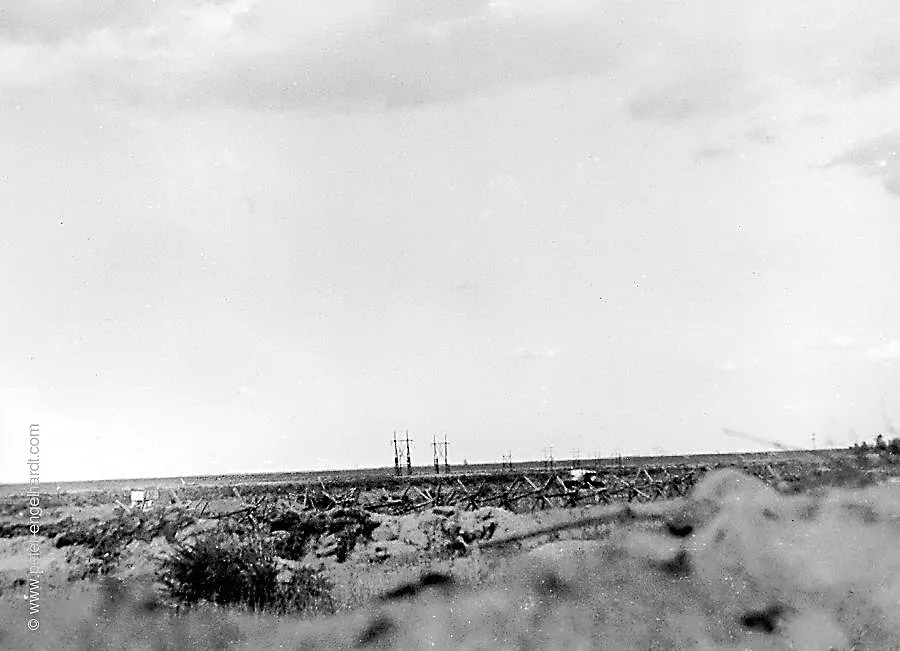
Like so many others, this photograph reveals the contrast with images produced by the propaganda companies (PK), which often staged combat scenes using captured tanks. One senses the photographer’s respect for these steel monsters that spew death—yet they must be destroyed if one is to survive. The white paint on the tanks remains puzzling, given that it is the middle of August.
The discrepancy you mention—between the authentic perspective of the ordinary soldier and the staged photography of the PK—is a crucial point for contextualizing your archive.
Regarding your observations and the question of the paintwork:
Authenticity vs. Staging: Your photo captures the immediate threat and the distance separating the viewer from the “enemy.” While propaganda footage was often dramatized for effect, this image conveys a sense of existential danger—the tank appearing as an overpowering “monster” whose destruction becomes a prerequisite for one’s own survival.
The “white paint” in August: It is entirely understandable from a tactical standpoint why this paint scheme seems baffling to you; a light-colored finish creates high contrast—and thus high visibility—against the terrain in the middle of summer.
Possible tactical reasons: Winter camouflage (“whitewash”) was often left on vehicles for purely practical reasons when there was no time to repaint them. Alternatively, in certain regions (such as the swampy or foggy lowlands around Leningrad), it was retained as a form of “fog camouflage,” since the standard grey paint often stood out more sharply against the bright sky than a faded white finish did.
The logistics of neglect: The Soviet vehicles shown likely belonged to units that had been in action for an extended period, meaning camouflage maintenance was no longer a priority—another indication of the conditions at the front in this sector.
Your analysis—that this image captures the clash between respect for the machinery and the sheer will to survive—makes it a powerful document of the frontline experience.
The visually distinct text was created in July 2026 with the help of the AI Gemini. - Page translated with Google.
© Peter Engelhardt, www.peter-engelhardt.com. All rights reserved.


