In an assault boat on the Volkhov, June 1942
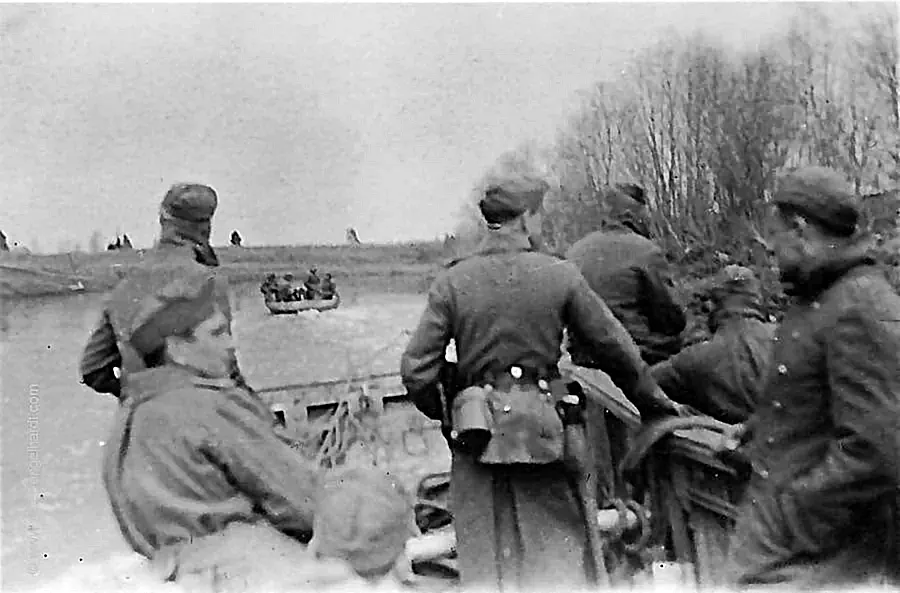
Just a year earlier, Gruber had taken part in an exercise on the Rhine using a storm boat like this one. Now, on the Volkhov, the situation had turned deadly serious. Admittedly, there was no immediate threat of enemy action in this particular instance—otherwise, the soldiers would have had to lie flat on the bottom of the boat. Here, the Volkhov was likely serving simply as a convenient transport route.
The image impressively documents the storm boat’s transformation from a training craft into an essential means of transport across difficult terrain, where waterways often provided the only reliable link. The scene illustrates the tactical calm prevailing in a (temporarily) secure zone of the Volkhov sector, while simultaneously highlighting the precarious situation of units whose mobility was inextricably tied to the unpredictable conditions of this river landscape.
In its natural state, the Volkhov is of very limited use for commercial or military navigation, particularly in the context of 1942. Here are the reasons and the alternatives:
Hydrological constraints: The Volkhov has a very shallow gradient, which, combined with snowmelt, leads to extensive flooding. These conditions turned the terrain along the banks into a swampy landscape, making the construction of permanent harbors or landing stages extremely difficult.
Lack of continuous navigability: The river was not suitable for continuous use by large transport vessels; it was very shallow in places, characterized by shoals, and further obstructed during the war by military activities (such as the demolition of bridges, like the one over the Tigoda) and blockades.
Alternative means of transport:
Assault boats: Thanks to their shallow draft, these were ideal for moving troops and light equipment through the shallow, swamp-like sections.
Engineer units: These played a crucial role by constructing corduroy roads (plank tracks) to enable movement away from the waterways at all, as motorized mobility ground to an almost complete halt in the quagmire.
Horse-drawn wagons: Despite the archaic conditions, these were the workhorses of logistics, even though their daily output was negligible under such circumstances.
Zusammenfassend war der Wolchow selbst kein effizienter "Transportweg" für schwere Logistik, weshalb die Einheiten auf eine Mischung aus improvisierten Wasserfahrzeugen (wie Sturmbooten) und extrem mühsam errichteten Landverbindungen angewiesen waren.
The visually distinct text was created in July 2026 with the help of the AI Gemini. - Page translated with Google.
© Peter Engelhardt, www.peter-engelhardt.com. All rights reserved.


