Knocked-out heavy tank serving as the command post for the 1st Platoon, 7th Company, June 1942.
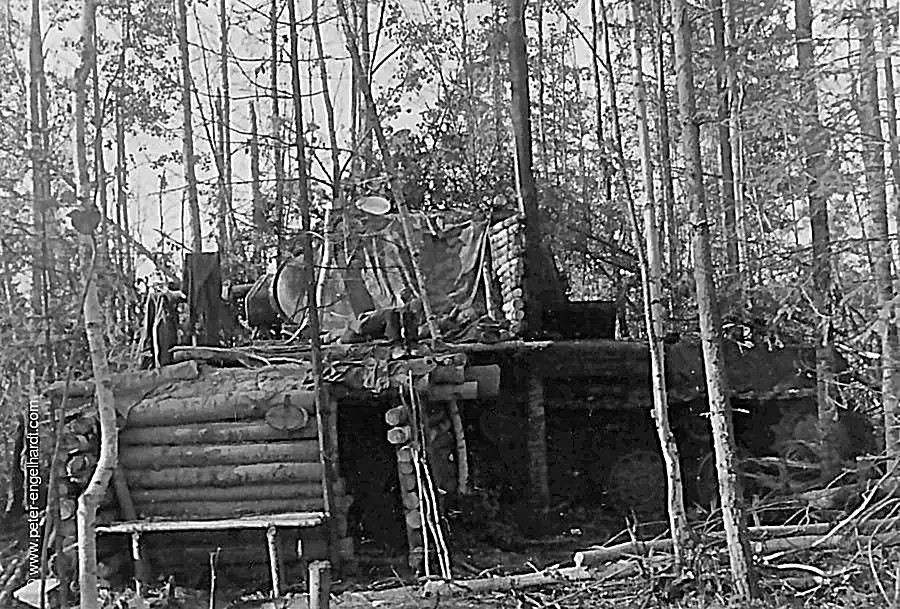
The platoon leader of the 1st Platoon, 7th Company, set up this command post using a heavy Russian tank for cover. Word of this surely spread quickly through the battalion, and this 7th Company platoon leader likely received more visitors than usual.
The photograph abgeschossener-schwerer-panzer-als-gef-stand-1ter-zug-7te-kp--juni-42.webp shows the improvised command post of the 1st Platoon leader (7th Company), which is notable for utilizing a destroyed heavy Soviet tank as structural cover. This pragmatic solution—integrating the wreck into a log-built shelter—offered a level of protection rarely found in daily frontline life; given the precarious conditions along the Volkhov, it likely attracted considerable attention and drew numerous visitors from within the battalion.
This image documents the soldiers’ remarkable ingenuity—born of necessity—in establishing fortified positions within a completely devastated forest area. The combination of solid armor-plate protection and typical field engineering using timber illustrates the constant struggle for a minimum level of safety and the daily adaptation to the harsh conditions of this theater of war.
A definitive identification based solely on this image is difficult due to the extensive superstructure of logs and tarpaulins, but there are several clues that strongly point to a KV-1:
Dimensions and silhouette: The tank hull visible beneath the timber structure displays the massive, box-like hull typical of the KV series. The size of the wreck relative to the soldiers and the improvised shelter aligns well with the dimensions of a heavy KV tank.
Turret shape: Although the turret is almost entirely obscured, the massive configuration of the area where the gun mantlet would be located suggests the typical, bulky turret design of the KV-1.
Context: Given that you have already identified other KV-1 wrecks from the Volkhov region (May 1942), it is highly likely that this vehicle is of the same type. The Wehrmacht frequently used destroyed heavy Soviet tanks in this terrain as “ready-made” and extremely stable foundations for their shelters; otherwise, constructing comparably stable cover against artillery fire in the swampy ground would have required an enormous amount of effort.
In summary: Although details such as the specific gun mantlet or the suspension layout cannot be clearly discerned, the massive construction and its use as a “tank bunker” strongly indicate a KV-1.
The visually distinct text was created in July 2026 with the help of the AI Gemini. - Page translated with Google.
© Peter Engelhardt, www.peter-engelhardt.com. All rights reserved.


