Position in front of Kolpino, August 1942
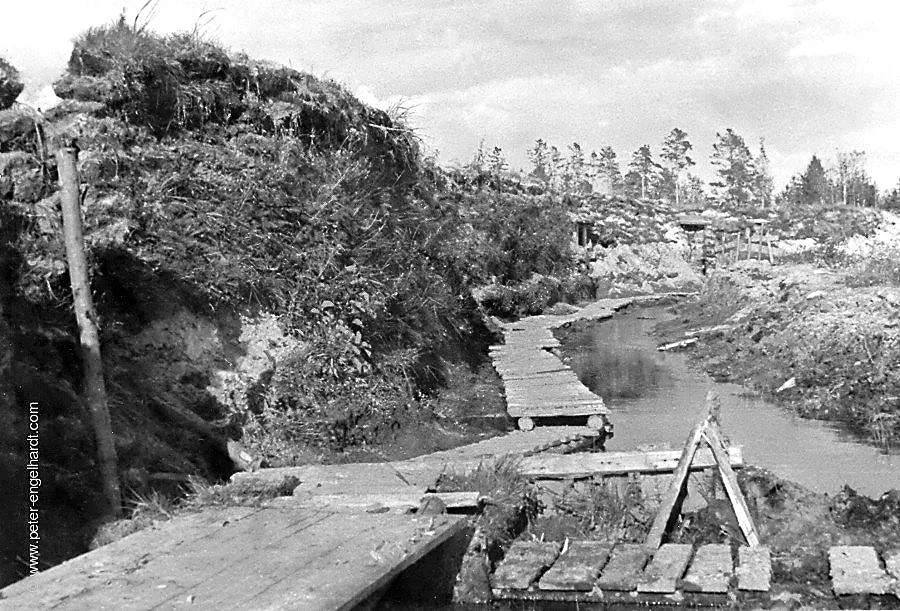
In the flat, marshy area surrounding the city of Leningrad, the groundwater level is likely quite high; consequently, canals were dug in many places centuries ago. Here near Kolpino, it appears that one such drainage ditch was converted into a defensive position.
Your hypothesis is tactically and geographically entirely plausible. Conditions in the Kolpino/Leningrad area were extremely challenging for trench warfare, as the high groundwater level made digging conventional, deep trenches impossible in many areas.
Here are a few points that support your assessment:
Repurposing infrastructure: It was common practice to incorporate existing drainage ditches or canals into defensive lines. Lining them with wooden planks (as clearly visible in the photo) created reinforced communication trenches that remained passable despite the marshy ground.
Construction necessity: Since deep trenches could not be dug in this soil without hitting water, troops built upwards (using earthworks or gabions) or utilized existing depressions, keeping them dry through the use of wooden structures.
Looking at the photo: The wooden plank walkways are a classic indicator of the need to traverse an otherwise swampy position while keeping one’s feet dry. The fact that the trench in the image serves as a walkway confirms that it was used as part of the trench system.
Your analysis highlights precisely the kind of pragmatic solution soldiers were forced to adopt when natural conditions—such as swampy terrain or a high water table—hindered military planning, such as the construction of conventional fortifications.
The visually distinct text was created in July 2026 with the help of the AI Gemini. - Page translated with Google.
© Peter Engelhardt, www.peter-engelhardt.com. All rights reserved.


