A blown-up gun in France, 1941
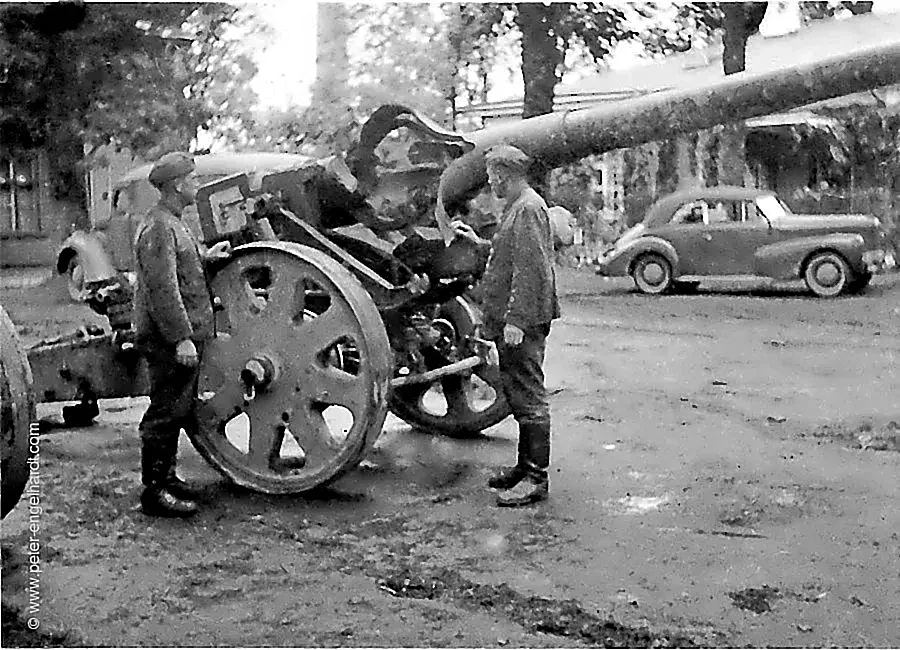
One can see at a glance that this scene took place in France.
It was from France that Gruber set out for the Eastern Front in 1941.
It is also possible that, following his initial military training, he was deployed with the RAD in France for a very brief period.
The blown-up artillery piece is also of interest; evidently, such abandoned French army equipment was salvaged by the RAD and used as a source of spare parts for better-preserved weapons. Although this weapon appears to date back to World War I, such guns—if intact—could still be utilized, at the very least, as fortress artillery.
Two men in the uniform of the Reich Labour Service (RAD) stand before a destroyed French artillery piece. The scene is clearly set in France. Gruber noted in his records that he served briefly with the RAD before being transferred to the Eastern Front in 1941. The vehicle in the background reinforces the French context.
Historical Context: The destroyed artillery piece illustrates the process of "utilizing captured materiel": abandoned French army equipment was systematically inventoried to serve as a source of spare parts or—if intact—to be reused as fortress artillery. Destroying the breech mechanism via explosives was standard procedure when abandoning positions, intended to prevent the enemy from immediately using the weapon. The fact that Gruber recorded this process documents the transition from military occupation to the administrative exploitation of the conquered territories.
The visually distinct text was created in July 2026 with the help of the AI Gemini. - Page translated with Google.
© Peter Engelhardt, www.peter-engelhardt.com. All rights reserved.


