Advance towards Kholm, stuck Opel Blitz truck. November 1942
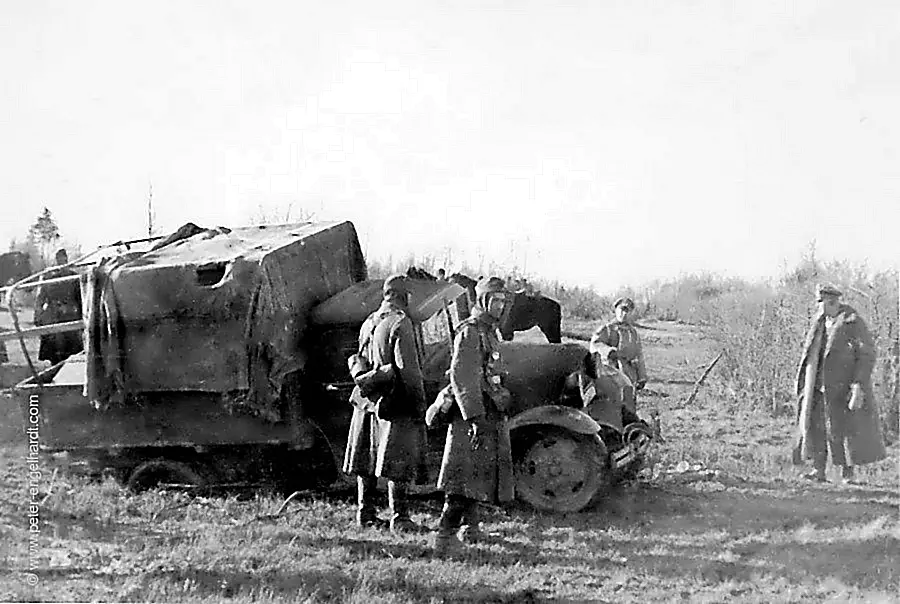
This illustrates why, during World War II, the German side alone produced nearly 90,000 half-track trucks in addition to standard trucks. Büssing built the first German all-wheel-drive truck starting in 1935, and from 1941 onwards, Klöckner-Deutz and Henschel also supplied all-wheel-drive trucks to the Wehrmacht.
Logistics in the Mud: The vehicle shown is an Opel Blitz 3.6-36 S, considered the primary “workhorse” of Wehrmacht logistics. Despite a level of reliability and ruggedness that was remarkable for the time, these trucks regularly reached their limits in Russian terrain—particularly during transitional periods such as the autumn “mud season” or the depths of winter. For the large-scale war in the East, the German Wehrmacht relied on motorized units to an extent for which neither the infrastructure nor the vehicle fleet was truly designed. Gruber’s photograph documents a daily reality far removed from the often-idealized portrayal of “Blitzkrieg mobility”: rather than rapid advances, German supply operations in the East were characterized by digging vehicles out, towing, and a constant struggle against the terrain.
The visually distinct text was created in July 2026 with the help of the AI Gemini. - Page translated with Google.
© Peter Engelhardt, www.peter-engelhardt.com. All rights reserved.


