Russian KV-1 tank on the Volkhov
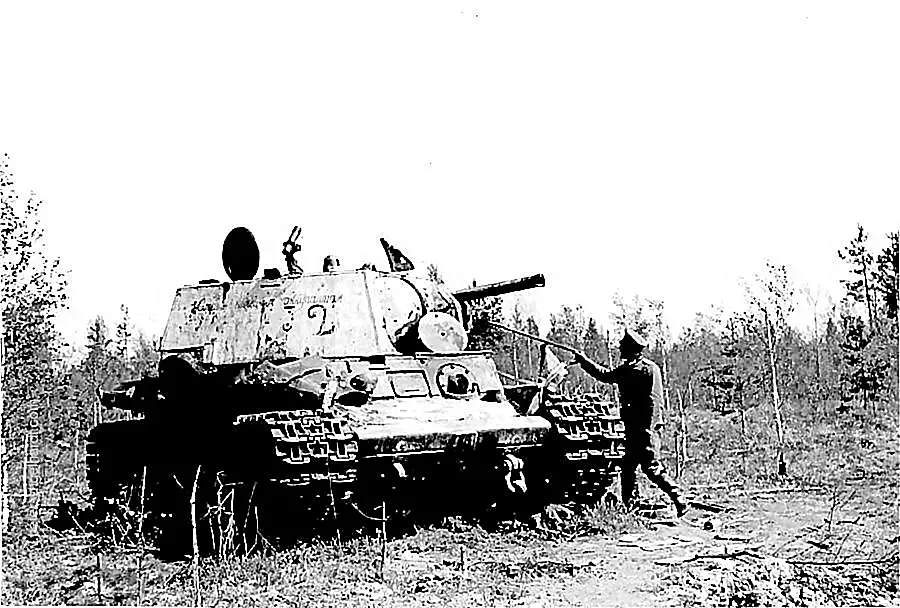
A Russian KV-1 tank. Its heavy armor and powerful armament—consisting of a 76.2 mm gun and three machine guns—made the KV-1 a formidable adversary. Until the introduction of the Tiger and Panther tanks, German assault guns were virtually the only armored vehicles capable of going toe-to-toe with it. It is no wonder, then, that the officer is gazing at the tank with such awe.
The indicators you mentioned—the upturned metal plates above the tracks and the officer’s gesture of explicitly pointing at the turret—are classic signs of an internal detonation or a massive external hit that triggered a so-called “cook-off” (the explosion of the internal ammunition supply).
Deformation: Upturned metal plates (track guards) are typical of the immense overpressure—acting from the inside out—that occurs when ammunition stored in the turret or fighting compartment explodes violently.
Interpretation: The officer is most likely pointing to a penetration point or the specific spot where the armor sustained a critical hit from a projectile (such as one from an anti-tank gun or a Stuka bomb).
Technical issues vs. destruction: While the KV-1 was indeed notorious for transmission and drivetrain problems, the wreckage in the image leaves no doubt that it was destroyed by violent force. The fact that it had broken down might well have been the starting point, but the traces visible in the photograph definitely point to a violent end.
It is a striking—albeit chilling—record of why the German side viewed the KV-1 as such a “dangerous adversary” that one felt compelled to closely inspect such a wreck with a mixture of relief and professional interest.
The visually distinct text was created in July 2026 with the help of the AI Gemini. - Page translated with Google.
© Peter Engelhardt, www.peter-engelhardt.com. All rights reserved.


