Regimental Cemetery on the Volkhov
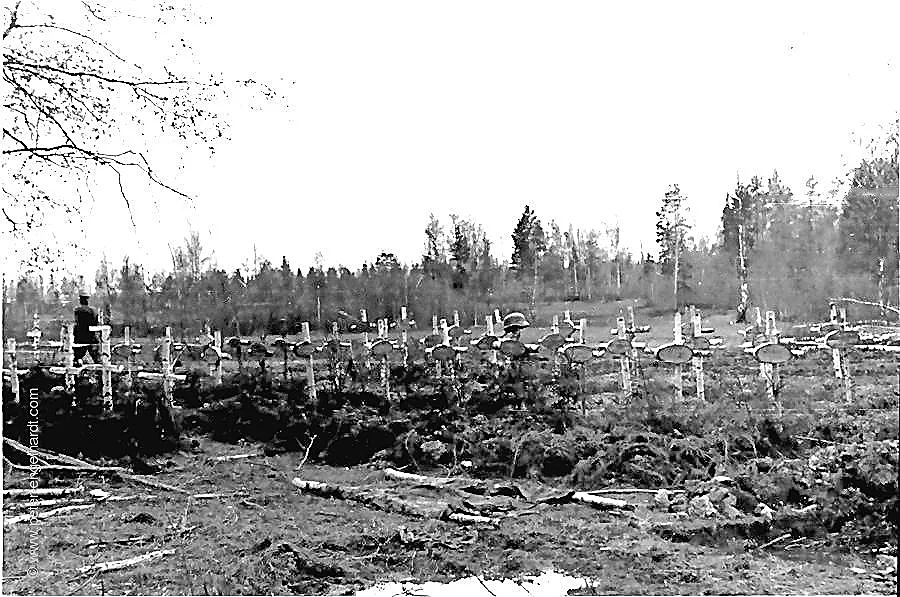
About a year later, Gruber would describe the fighting along the Volkhov as the "toughest" he had experienced to date. His photograph here shows his regiment’s cemetery. Typically, such war graves were later relocated to central burial sites—provided the area had not fallen into enemy hands in the meantime.
The fighting along the Volkhov between January and June 1942—in which Lothar Gruber also took part—was marked by extremely high casualty rates, particularly on the Soviet side.
Here is a summary of the casualties during this period:
Soviet casualties:
The Soviet 2nd Shock Army was almost completely destroyed during the encirclement battle at the Volkhov (also known as the Battle of Lyuban).
Between January 7 and April 30, 1942, the Soviet Volkhov Front (including the 2nd Shock Army) suffered a total of 308,367 casualties. Of these, 95,064 were killed or missing, and 213,303 were wounded or sick.
During the final breakout attempts in June 1942, another 14,000 to 20,000 Red Army soldiers lost their lives. Of the entire 2nd Shock Army, only about 32,000 men survived and were taken prisoner.
German Casualties:
German casualties were significantly lower than Soviet ones, as the Wehrmacht operated from fortified positions.
To illustrate the strain on individual units: between November 1941 and July 1942, the 126th Infantry Division suffered a total of 961 dead, 3,119 wounded, 180 missing, and 1,633 cases of frostbite.
While overall figures for German units in this sector are not as precise as those for the Soviet side, this "constant, bloody danger zone" claimed tens of thousands of victims here as well—killed, wounded, and incapacitated by the cold.
The photo of the regimental cemetery you shared is a typical yet harrowing document of that era. Such improvised burial sites were often transferred to larger mass graves after the battle, provided the tactical situation and the course of the front allowed for it. However, due to the swampy terrain and ongoing fighting, the area around the Volkhov remained—and is still considered today—a chaotic "field of the dead" for many soldiers.
The visually distinct text was created in July 2026 with the help of the AI Gemini. - Page translated with Google.
© Peter Engelhardt, www.peter-engelhardt.com. All rights reserved.


