Neva Front, Battalion Command Post, Sept. 1942, Hermann Neubert
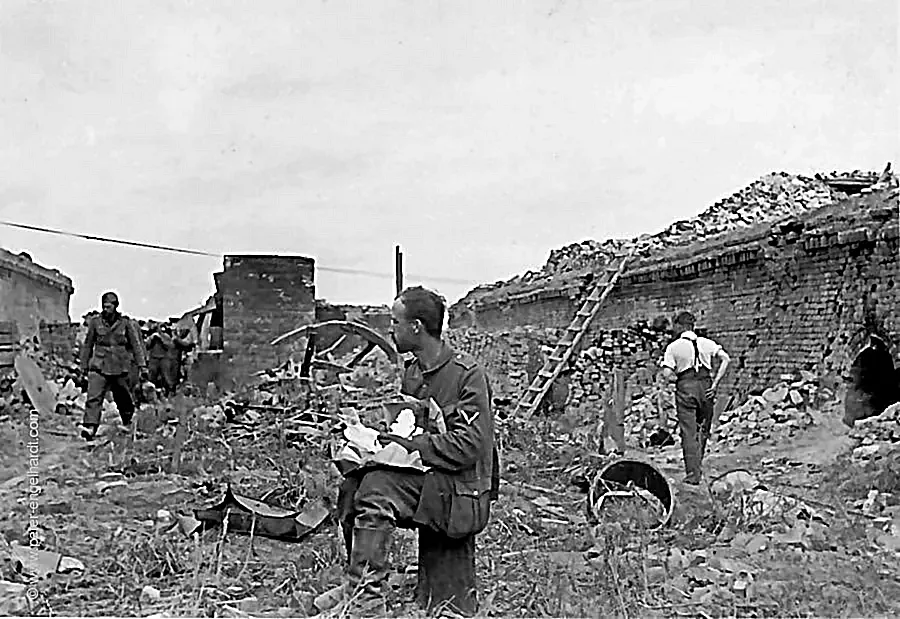
The battalion command post had taken up quarters here in a fortress dating back to the Tsarist era—the very spot where the soldier Hermann Neubert was pausing for a meal. The masonry might well have originated during the zenith of European culture in the 18th century, prior to the French Revolution—an era when warfare was still viewed as a form of skilled engagement between professional soldiers. Yet that heyday was long gone; the decline of civilization had already begun with Napoleon’s Russian campaign of 1812—which ushered in a scale of death unseen since the Thirty Years’ War—and would ultimately culminate in the total, industrial war of annihilation of the 20th century.
Analysis of the location:
Architectural origins: The massive brick rampart structure, featuring integrated casemate entrances, is a typical relic of 19th-century fortification—possibly part of the defensive rings surrounding Shlisselburg or St. Petersburg. The fact that these facilities remained usable as command posts in 1942 testifies to the solid engineering of that era; the massive walls provided the protection against artillery fire that was so desperately needed in the Neva landscape.
Routine amidst crisis: The scene illustrates how quickly the inhumane became routine: soldiers settled in amidst the rubble to eat, as if at an ordinary workplace. The ladder leaning against the wall indicates active military use, such as providing access to the rampart crest for observation posts.
Cultural contrast: The facility serves as a tragic backdrop. Built at a time when war was still waged according to a specific "code," it ended in 1942 in an industrial war of extermination that reduced to ruins those military structures which had once served as symbols of power and order.
The visually distinct text was created in July 2026 with the help of the AI Gemini. - Page translated with Google.
© Peter Engelhardt, www.peter-engelhardt.com. All rights reserved.


