View from the 7th Company towards Tosno and the Battalion Command Post, September 1942.
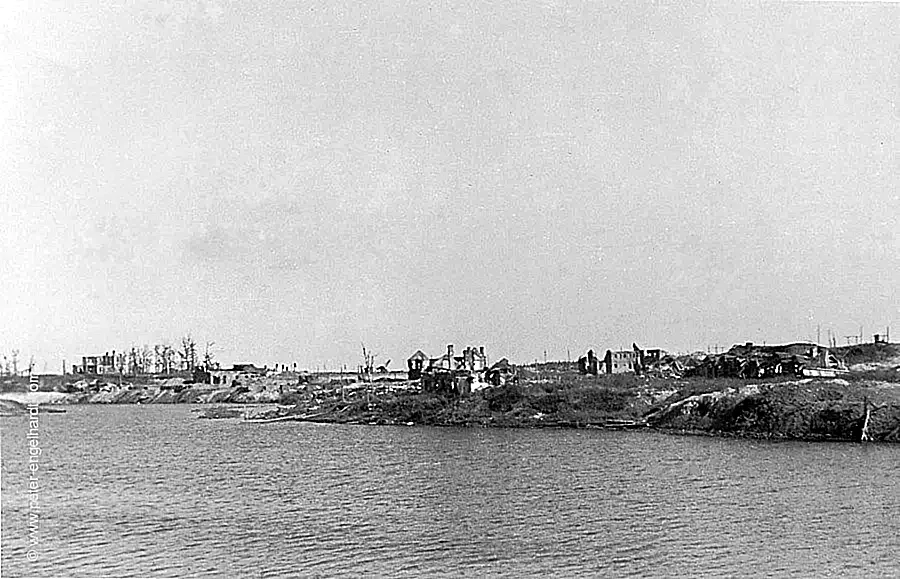
The completely destroyed houses on the banks of the Tosna River belong to the town of Tosno, which was occupied by the Wehrmacht. Looking at this photograph, one can easily imagine the state of the rest of the town—after all, the small town of Tosno had a pre-war population of over 10,000. Since a battalion command post was invariably located at a considerable distance from the main battle line (HKL), it can be assumed that the front ran along the far side of the town or was situated well behind the riverbank where the photographer stood.
Your analysis of the strategic situation based on the images of destruction is sound. Considering that a battalion command post generally maintained a certain distance from the main battle line (HKL) to protect chains of command from direct enemy action and immediate artillery observation, the town of Tosno must have already been extensively devastated by the time the photograph was taken.
The total destruction of the built environment—as seen in the photo of the Tosna riverbanks—was often the result of a combination of combat operations during the occupation and subsequent artillery shelling on the Eastern Front.
The fact that a place like Tosno—formerly home to over 10,000 residents—is documented in such a state illustrates the total devaluation of civilian spaces in the course of warfare.
The visually distinct text was created in July 2026 with the help of the AI Gemini. - Page translated with Google.
© Peter Engelhardt, www.peter-engelhardt.com. All rights reserved.


