Narva 1941; on the left, the German castle; on the right, the Russian castle.
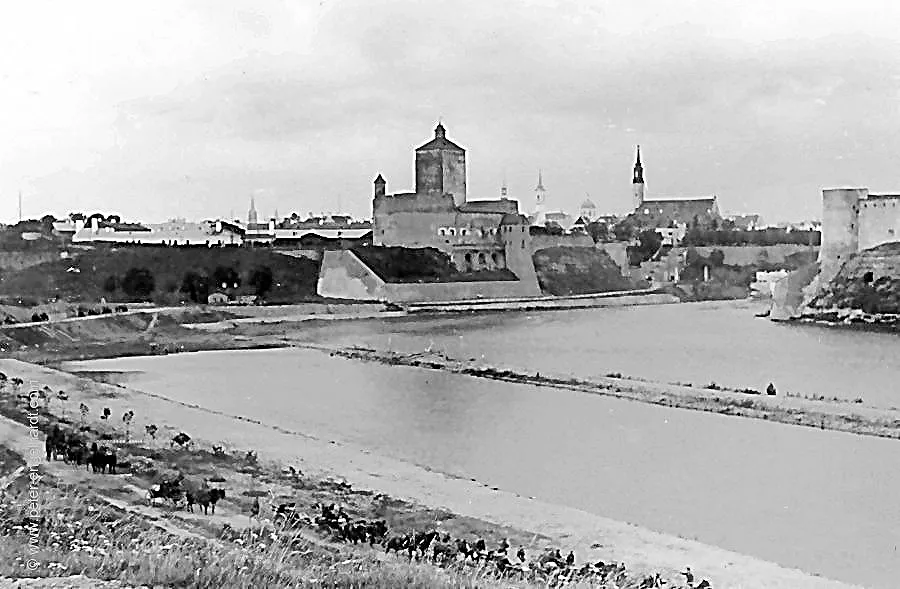
A view of the city of Narva, Estonia, in September 1941, showing the Russian fortification on the right bank. German military columns appear in the foreground. When comparing this with more recent photos of the same location found online, one immediately notices that the impressive churches and their spires have sadly disappeared.
The photograph was taken from a well-known vantage point on a rise outside Narva—the site where the “Vaateplatvorm” (viewing platform) is located today.
Reasons for the Change in the Cityscape
Destruction during World War II: During the battles for Narva in 1944, the city was largely razed to the ground by massive air raids and artillery fire, primarily from the Soviet side. Many historic buildings and churches were severely damaged or completely gutted by fire.
Soviet Post-War Policy: After the war, the Soviet administration made a deliberate political decision not to rebuild the city in its historic form. Instead of the old Estonian/German architecture—which was viewed as alien or “feudal”—Narva was to be redesigned as a “socialist industrial city.”
Systematic Demolition: The surviving ruins of historic churches—which might have been restored following the hostilities—were deliberately demolished in the post-war period to make way for modern Soviet apartment blocks (prefabricated concrete buildings) and a new urban layout.
The visually distinct text was created in July 2026 with the help of the AI Gemini. - Page translated with Google.
© Peter Engelhardt, www.peter-engelhardt.com. All rights reserved.


