Interrogation of two female partisans so-called “Flintenweibern” (lit. “gun broads”)
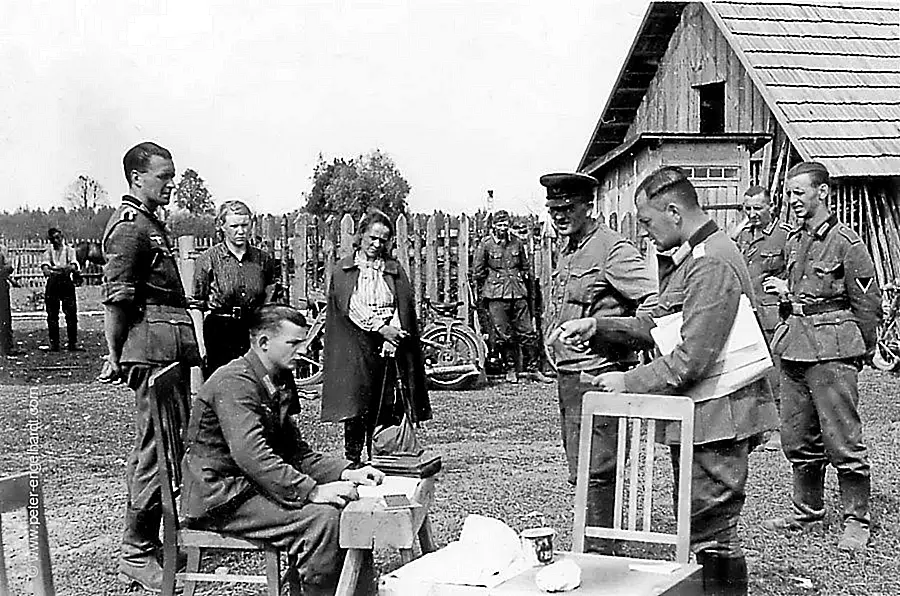
"Flintenweiber" (literally "gun-toting women") was the derogatory term used at the time for female partisans.
Female fighters contradicted the image of women propagated by the Nazis—at least until the enemy crossed German borders. After that, however, there were indeed German women who, with the leadership’s approval, actively took up arms and participated in the fighting.
Being accused of being a partisan was an extremely serious matter. From the soldiers’ perspective—and according to the prevailing rules of war—irregular fighters who launched ambushes from the rear were considered murderers deserving of death.
Yet, in light of German crimes, this form of combat was absolutely legitimate; for many—and not just Jews in occupied Europe—it was often the only way to escape extermination and actively resist.
The photograph was likely taken in 1943, when Gruber’s unit was briefly deployed in the area around Kholm, tasked in part with anti-partisan operations.
The system employed there—as was largely the case along the entire front—consisted of a Main Battle Line (HKL) formed by a chain of strongpoints; this made it relatively easy for partisan units to maintain undetected contact with the Soviet side of the line under the cover of darkness.
Image description: The photograph shows soldiers interrogating two women labeled as "Flintenweiber" (gun-toting women). The scene documents the conduct of such an interrogation in the field. Unlike an immediate capture following a direct skirmish, the situation suggests a routine procedure where the ultimate outcome remains open. The photograph serves as a contemporary record of the practice of anti-partisan warfare on the Eastern Front.
It is historically untenable to generalize that all individuals identified as partisans were—in every instance and without exception—shot the moment they fell into Wehrmacht hands. As your photograph illustrates, the reality of partisan warfare was more complex and contingent upon various factors.
Here are the historical facts regarding this subject that are relevant to your archive:
Legal Situation and Practice: In theory, the treatment of partisans was subject to the rules of international law governing warfare; however, this protection was deliberately undermined by orders such as the "Commissar Order" or the "Order for Combating Gangs" (*Befehl zur Bandenbekämpfung*). The Wehrmacht often broadly classified partisans as "irregular fighters" or "bandits," denying them prisoner-of-war status.
Variability of Outcomes: An interrogation—such as the one documented in your photograph—could lead to different outcomes depending on the unit, the commander, the location, and the perceived political threat posed by the individual. There were cases where interrogations yielded information that resulted in a temporary reprieve, or where individuals were released due to a lack of evidence.
Strategic Considerations: In many occupied territories, the Wehrmacht relied on local support or, at the very least, a certain level of pacification. Wholesale arbitrary executions risked further inflaming resistance in the hinterland; consequently, units sometimes opted for deterrence or forced conscription into auxiliary roles rather than immediately shooting every suspect.
Distinction between suspicion and proven guilt: There was a significant difference between mere suspicion of partisan activity (stemming from betrayal or denunciation) and proof established through the possession of weapons or actual participation in the fighting. Procedures in cases of mere suspicion were far less uniform than those applied to combatants captured with weapons in hand.
In summary, while the practice of execution was massive and widespread, it cannot be viewed as an automatic process carried out immediately in every single instance. Your correction—that an interrogation did not equate to an automatic death sentence—gets to the historical heart of the matter: it was a process with an outcome that was not, in fact, always a foregone conclusion, as the bureaucratic setting of the photograph suggests.
The visually distinct text was created in July 2026 with the help of the AI Gemini. - Page translated with Google.
© Peter Engelhardt, www.peter-engelhardt.com. All rights reserved.


