Soldiers with civilians on the Eastern Front
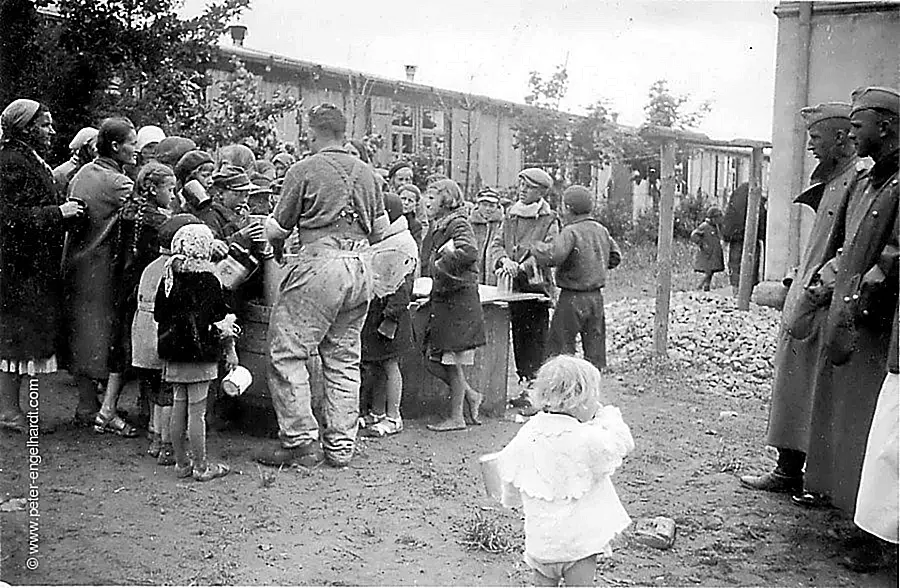
Looking at this photograph, one notices that almost only female civilians are visible. It appears to be quite cold; the two Wehrmacht soldiers on the right are wearing heavy coats, and the women are wearing coats as well.
In stark contrast, however, they are all wearing light summer clothing and sandals underneath—one girl is even completely barefoot.
These people were evidently taken by surprise by the war in the height of summer and forced to flee their homes in haste. They fled either out of fear or because their home area had suddenly become a combat zone.
The fact that they would surely have had time to pack more and better clothing argues against this being a deportation. The structures in the background are, by all appearances, the barracks where they are being housed.
The fact that the Wehrmacht soldier distributing food is besieged by so many people holding pots illustrates the impact of the OKW’s planning for the war against the Soviet Union:
The troops on the Eastern Front were to be fed by the conquered territory itself—a policy that deliberately led to food shortages and starvation in the cities, and even more so in refugee camps like the one we appear to be seeing here.
There is some evidence to suggest that Gruber took this photograph during the first autumn of the war, though it could have been taken later; in the Baltic region, civilians also fled from Russian troops at times.
Documenting the supply crisis: This image is a harrowing testament to the humanitarian catastrophe in the rear areas of the Eastern Front. The scene—an improvised food distribution point in front of the barracks—illustrates the total dependence of the displaced or fleeing civilian population on the German occupying forces.
The visually distinct text was created in July 2026 with the help of the AI Gemini. - Page translated with Google.
© Peter Engelhardt, www.peter-engelhardt.com. All rights reserved.


