Battalion staff on the advance. Crossing a tributary of the Luga.
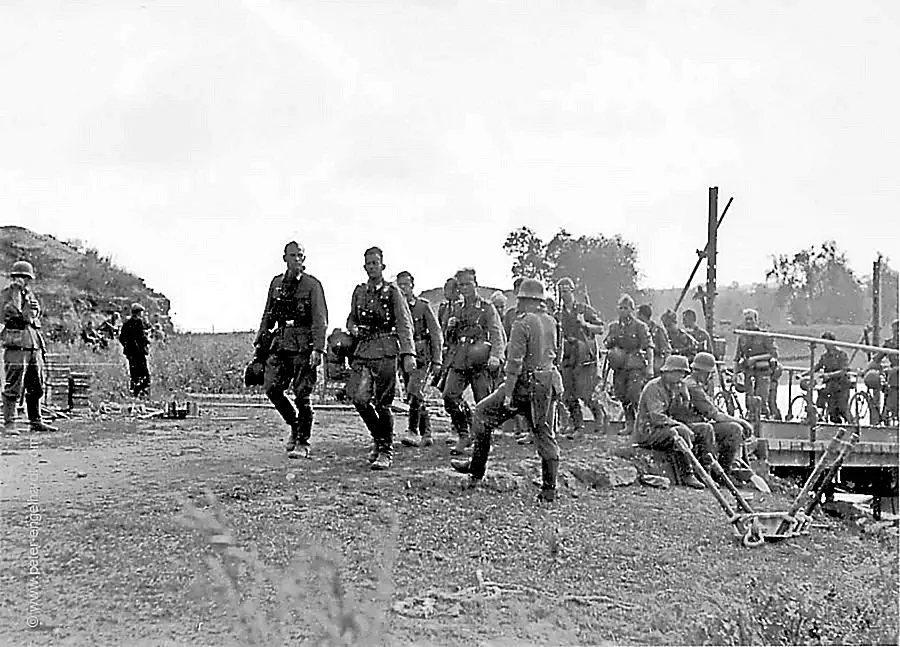
It is difficult to pinpoint the exact date of this photograph of Soldier Gruber. While the term "advance" might suggest the deployment to Kholm, that move took place in late autumn 1942, whereas the photo conveys a distinctly summery atmosphere. Bicycles—like those the soldiers are pushing across the makeshift bridge—do not appear in later photographs, which reinforces the assumption that the image dates to 1942.
The Dynamics of the Advance: The structure in the background is undoubtedly a makeshift bridge—the kind combat engineers would rapidly erect over rivers or ditches during the summer phases of the advance. The sight of soldiers pushing their bicycles across this temporary crossing highlights the significantly greater mobility characteristic of this phase. The image conveys a sense of dynamism that differs fundamentally from the static, hardship-filled winter of 1943/44, thereby supporting the conclusion that it dates to the summer of 1942.
Bicycles in the Eastern Campaign: Bicycles (known as "troop bicycles") were used on the Eastern Front throughout the war. Nevertheless, your assumption that they serve as a chronological indicator in this photo is well-founded: while they were actively used during the mobile advances of 1941 and 1942, they virtually disappeared from the front-line landscape in later years for units like Gruber’s mortar squad. This was due to the shift toward static trench warfare, extreme wear and tear, and the loss of the vehicles. The fact that bicycles are still visible here as a means of troop transport on a makeshift bridge strongly points to the early, more dynamic phase of the Eastern Campaign.
The visually distinct text was created in July 2026 with the help of the AI Gemini. - Page translated with Google.
© Peter Engelhardt, www.peter-engelhardt.com. All rights reserved.


