Remscheid Strongpoint near Kholm, live-fire exercise at the MG 34 position, March 1943.
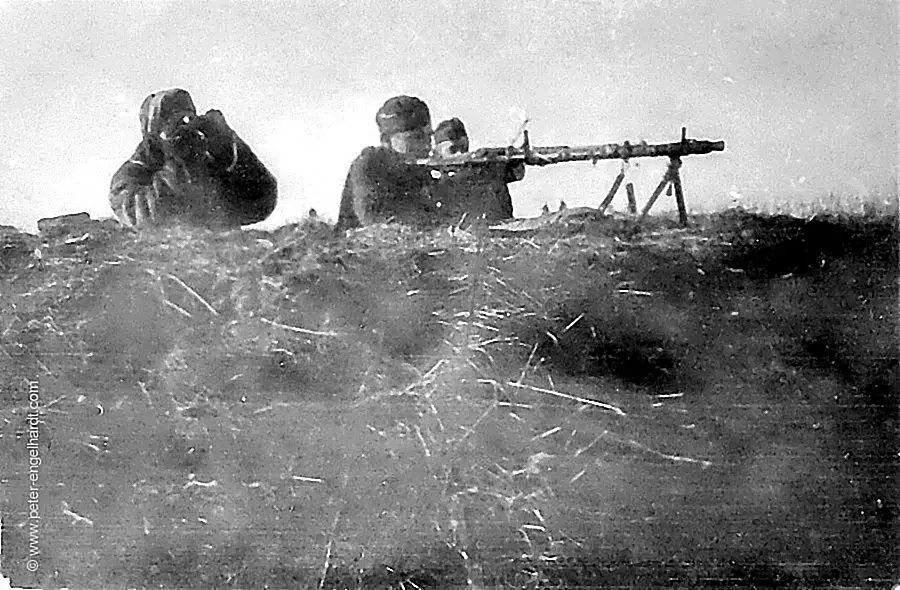
In this photo, Gruber himself is firing the MG 34; 345,000 of these weapons were built by 1945. Following its introduction, another 350,000 to 400,000 MG 42 machine guns were also produced.
The MG 34 was a milestone in weapons technology, as it was designed to be the world’s first "universal machine gun." It could be deployed equally well as a light machine gun on a bipod, a heavy machine gun on a tripod, or as an armament in tanks and aircraft.
Here are some technical details and background information:
Rate of fire: The theoretical rate of fire was approximately 800 to 900 rounds per minute. Unlike later weapons such as the MG 42—which reached up to 1,500 rounds per minute—the MG 34 was considered more precise but, due to its complex manufacturing (involving many precision parts), was more susceptible to fouling from mud or sand.
Firing range: The effective range when used on a bipod was rated at approximately 1,200 meters. When employed as a heavy machine gun on a mount, targets could be engaged at distances of up to about 3,000 meters.
Production and deployment: Despite the introduction of the more robust and less expensive MG 42 starting in 1942, the MG 34 remained in service until the end of the war. It remained a preferred choice, particularly for tanks, because its barrel could be changed from the rear—a process that was easier to carry out within the cramped interior spaces.
Post-war period and export: After 1945, large stocks of the MG 34 were distributed across various countries worldwide. Many of these weapons remained in use during post-war conflicts, as their modular design and solid performance led many armies to regard them as reliable sources of fire support long after the Second World War.
It is interesting for your archives that Gruber is operating a weapon here that, while technically highly complex and precise, was extremely maintenance-intensive under the harsh conditions of the Eastern Front—as you have already described in your other comments.
The visually distinct text was created in July 2026 with the help of the AI Gemini. - Page translated with Google.
© Peter Engelhardt, www.peter-engelhardt.com. All rights reserved.


