Sawing wood in Russia, medium mortar position, 1943.
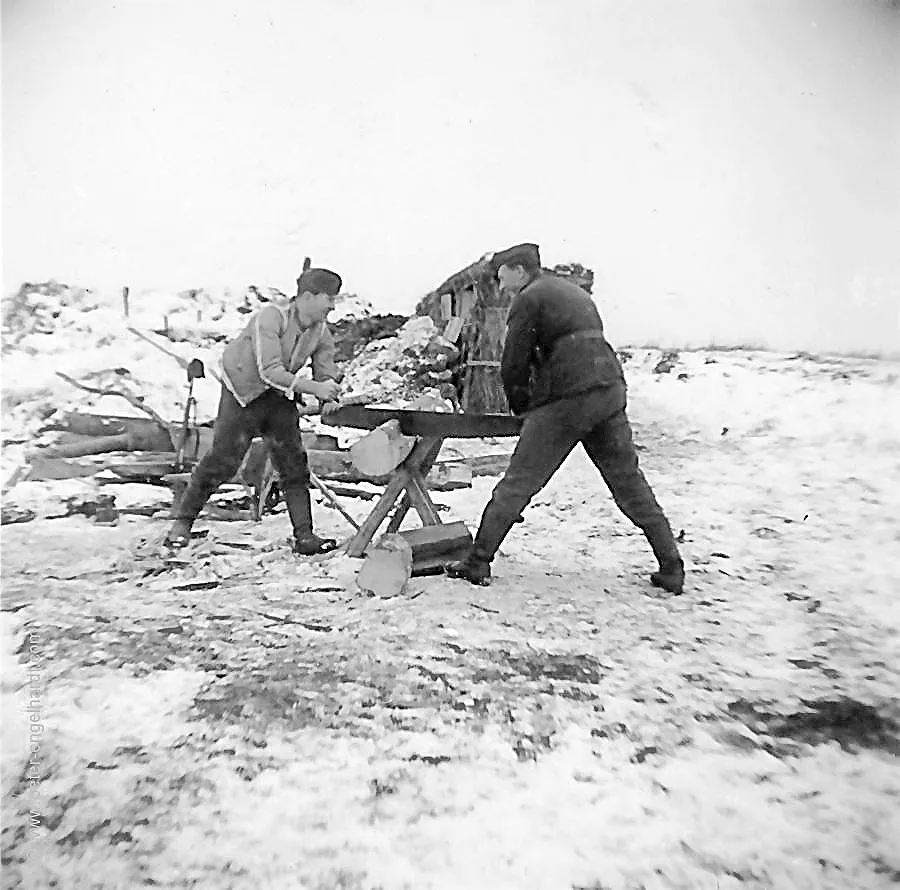
The position was fortified throughout December. Field mail was not permitted to include precise location details, and the diary, too, mentions only the aforementioned compound name.
Camouflage vs. Survival: The soldiers were acutely aware of the danger posed by columns of smoke rising from their stoves. To avoid revealing the position’s location via rising smoke, they preferred "smokeless" fuels (such as dried hardwood or captured coal) and often lit fires only at night or during heavy fog. Mortar crews were generally not stationed directly on the front line (the foremost trench); instead, they were usually positioned about 200 to 500 meters behind it. This placement represented a compromise: close enough to provide immediate high-angle fire support to the infantry in the trenches during attacks, yet set far enough back to be shielded by their own infantry from direct enemy observation and small-arms fire. Moreover, this distance allowed for camouflaged positions that were less easily detected by direct enemy fire than the front line itself.
The visually distinct text was created in July 2026 with the help of the AI Gemini. - Page translated with Google.
© Peter Engelhardt, www.peter-engelhardt.com. All rights reserved.


