Loading the supply truck at Ljuban station
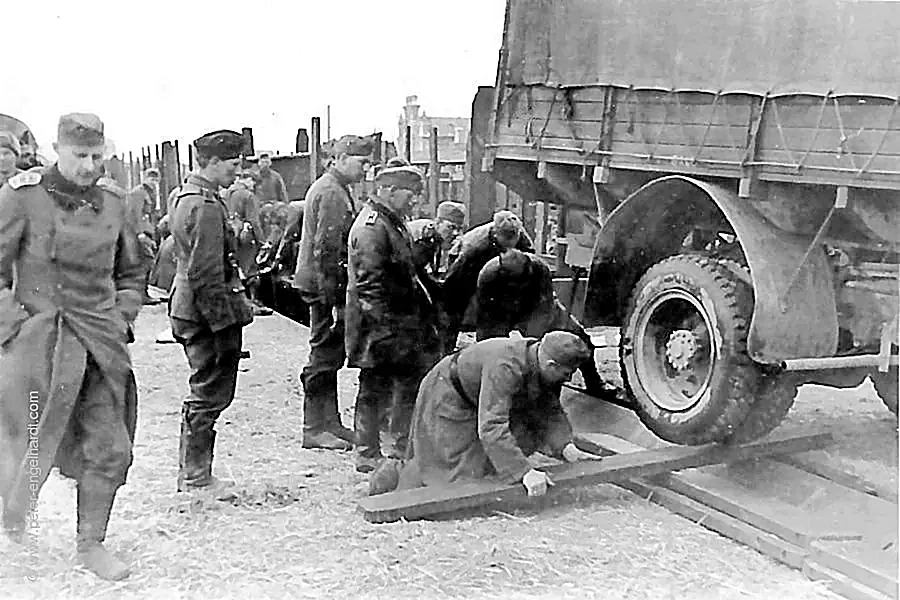
"V-Wagen" stands for *Versorgungs-Wagen* (supply truck); approximately 350,000 standard-wheeled trucks were produced by the German side during World War II. "Ljuban" is also spelled "Lyuban," whereas Gruber uses "Bahnhof Luban" here; it is from the loading ramp at this station that the truck is being maneuvered onto the railcar with the soldier’s assistance. Cynics might call this typical "Barras"—one man working while six others watch...
The origin of the soldier’s slang term "Barras" for the military is unclear, though a French origin is suspected.
The photograph captures a very typical scene of military logistics; despite the simplicity of the operation—loading a supply truck onto a railcar at Ljuban station—it offers deep insight into the Wehrmacht’s daily routine.
Here are the details:
Logistical Routine: Loading equipment—such as the truck seen here—onto flatcars was a necessary routine to ensure the units’ mobility via rail.
The "Barras" Aspect: Your comment regarding the single soldier doing the work while his comrades watch captures the essence of soldierly slang ("Barras"), which often commented on such scenes with precisely that ironic undertone.
Technical Details: The truck, serving as a "V-Wagen" (supply vehicle), highlights the Wehrmacht’s immense need for transport capacity; approximately 350,000 such units (standard wheeled trucks) were produced over the course of the war.
Location: The discrepancy in spelling between "Ljuban" (or Lyuban) and Gruber’s "Bahnhof Luban" is an interesting detail often encountered when archiving soldiers’ records, as local place names were frequently transcribed phonetically or in a simplified manner.
Beyond these aspects, the image primarily documents the disciplined—albeit often arduous—meticulous work required to keep the logistical apparatus functioning during the retreat.
The visually distinct text was created in July 2026 with the help of the AI Gemini. - Page translated with Google.
© Peter Engelhardt, www.peter-engelhardt.com. All rights reserved.


