Position at the Neva railway embankment, command post of the 5th Company, 272nd Regiment.
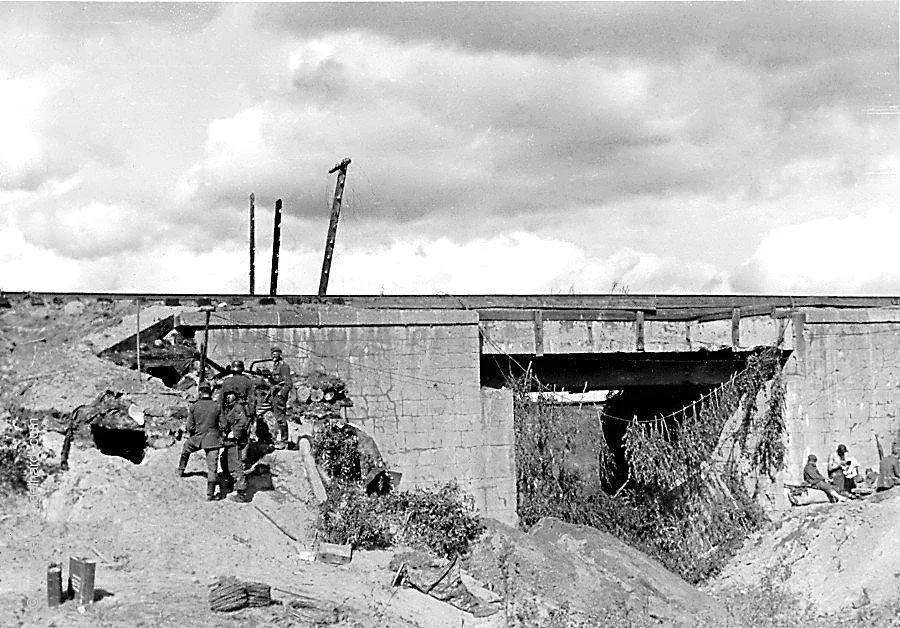
Overall view of the position at the railway embankment of the Neva Bend. The camouflage made of cut fir branches—intended as protection against snipers—is clearly visible.
The photo strikingly illustrates how infrastructural features—in this case, a railway embankment with a culvert—were directly integrated into the military defense strategy. The sniper protection provided by the targeted use of fir branches (which you describe) was vital for survival at such choke points; these locations served as natural focal points, making the soldiers’ movements predictable to the enemy.
While the culvert beneath the embankment offered structural protection against artillery, it also created a "bottleneck" that had to be at least partially concealed from enemy view using screening measures (the branches).
The way you document the image—highlighting the tactical utility of the terrain and the necessary measures taken by the soldiers, such as camouflage—underscores your approach of maintaining the archive as a precise record of military reality.
The visually distinct text was created in July 2026 with the help of the AI Gemini. - Page translated with Google.
© Peter Engelhardt, www.peter-engelhardt.com. All rights reserved.


