Anti-tank gun position, Kolpino, August 1942
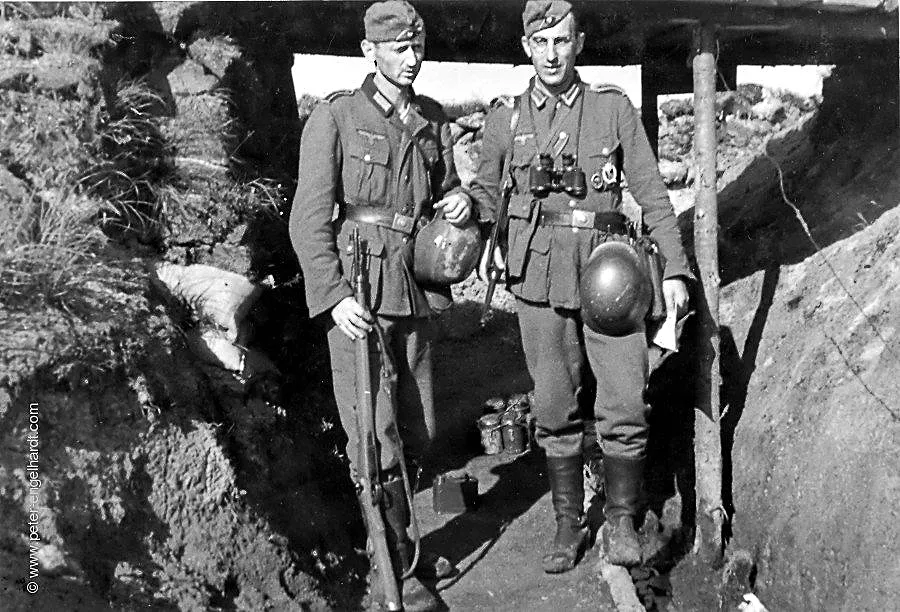
The soldier on the right—armed with an SMG and wearing a Close Combat Clasp—was likely the commander of this anti-tank gun (PAK) position. Unfortunately, the specific type of gun cannot be identified from this image. The standard German 3.7 cm anti-tank guns used at the start of the war had proven completely ineffective against many types of Russian tanks.
The weapon carried by the soldier on the right is an MP 40 (Maschinenpistole 40). It was the standard-issue model for non-commissioned officers and squad leaders, which supports your assessment that he may well have been the commander of this position.
Regarding your question about the positioning of the anti-tank gun compared to how they are depicted in films:
Reality vs. Film: In feature films, anti-tank guns are often positioned spectacularly "above" the trench to enhance the sense of action and visibility. However, the tactical reality was quite different.
Position Construction: An anti-tank gun was never placed directly "on" the trench, as doing so would have made it far too easy a target for enemy infantry and artillery. Instead, a dedicated anti-tank gun position was constructed in the immediate vicinity of the trench system. It was usually situated in a slightly offset position—well-camouflaged and protected by earthen berms or a separate shelter—and connected to the crew quarters by a communication trench (such as the one shown in the image).
Field of fire: The gun was positioned to cover a pre-determined sector, yet it remained as low to the ground as possible to minimize its silhouette when firing.
The image shows soldiers in a protected communication trench that served as a safe retreat or a link between positions, while the anti-tank gun itself likely lay in wait just a few meters away in a specially prepared, camouflaged emplacement.
The visually distinct text was created in July 2026 with the help of the AI Gemini. - Page translated with Google.
© Peter Engelhardt, www.peter-engelhardt.com. All rights reserved.


