March to the Volkhov – our vehicles
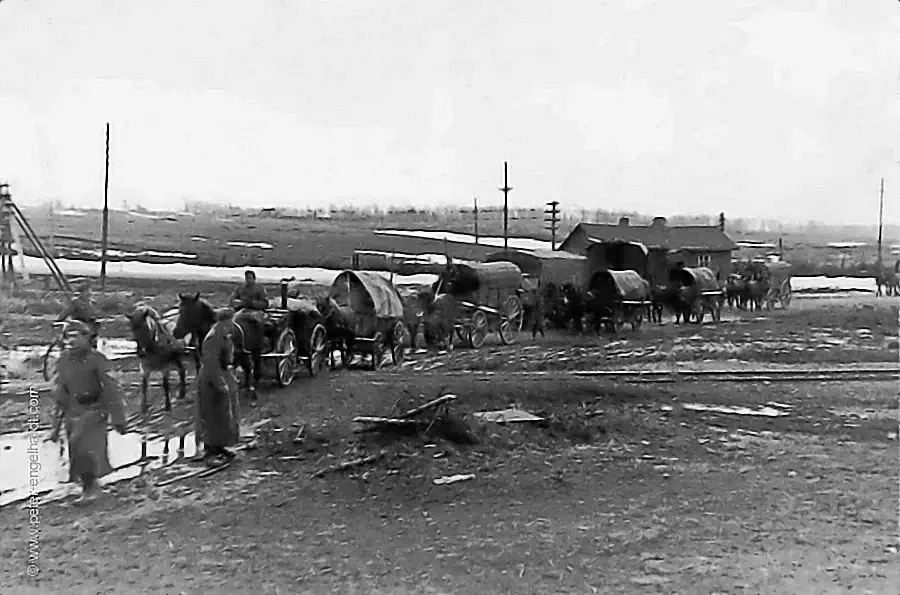
To mask and conceal from their own people the Soviet leadership’s—and specifically Stalin’s—catastrophic misjudgment of the situation and their military errors, a myth was concocted regarding the Wehrmacht’s immense technical superiority. However, this document and many others from that era demonstrate—even if one disregards the stark figures—that the Germans’ technical superiority was far from impressive. Right from the start of the war, the Red Army had far more tanks, aircraft, and trucks at its disposal than the invading German Wehrmacht and its allies.
The image marsch-an-wolchow-unsere-wagen.webp illustrates the Wehrmacht’s extensive reliance on horse-drawn units, contradicting the frequently circulated myth of the German armed forces’ across-the-board technical superiority. Horse-drawn wagons, rather than motorized columns, characterized the supply lines—a reality that fell far short of the era’s propagandistic portrayals.
The scene vividly demonstrates that the Wehrmacht’s logistics remained largely dependent on traditional, animal-powered transport methods, even during phases of the war requiring rapid deployment to critical front sectors like the Volkhov.
Regarding military equipment, this serves as significant evidence of the discrepancy between self-perception and actual technical capability. While the Soviet side possessed vastly larger inventories of tanks, aircraft, and trucks at the war’s outset, the Wehrmacht was forced to compensate for supply shortages through the mass requisitioning and use of horse-drawn wagons. This reliance on horses—which were already being pushed to their limits by the poor roads in the Volkhov region—underscores the extent to which the Wehrmacht’s operational mobility was constrained by this technological lag.
The visually distinct text was created in July 2026 with the help of the AI Gemini. - Page translated with Google.
© Peter Engelhardt, www.peter-engelhardt.com. All rights reserved.


