Corduroy road at a pioneer bridge over the Tigoda. Retreat from the Volkhov, August 1942
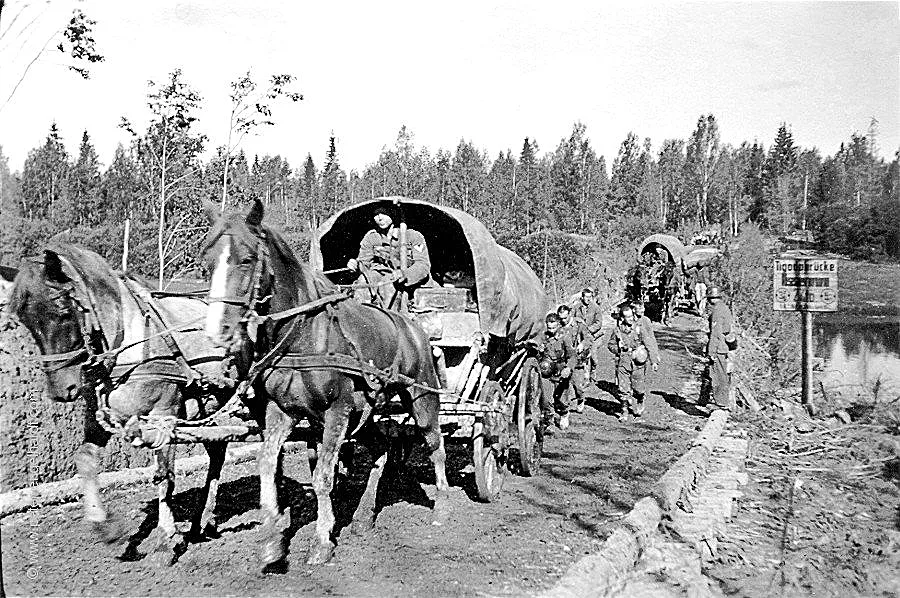
Although hardly any of these soldiers likely survived the war alive and uninjured, looking at this photo instinctively brings to mind those magnificent Wehrmacht horses—and how much longer they had left to live. Besides details regarding maximum load capacity (24 tons) and other specifications, the sign bears the name "Tigoda Bridge."
The photo is a harrowing visual complement to your research on the events in the Volkhov region in 1942. The contrasts you describe are unsettling:
The tragedy of the horses: The Wehrmacht relied heavily on horse-drawn units. The fact that, upon seeing these "magnificent" animals, you immediately associate them with their uncertain fate amidst the brutal conditions of the Russian forests and swamps underscores the fleeting nature of the moment preserved in these photographs.
The "Tigoda Bridge" infrastructure: The mention of the bridge (spanning the Tigoda River) and its 24-ton load capacity highlights the immense logistical effort behind these makeshift corduroy roads. Such bridges were bottlenecks for retreat and supply lines—and, consequently, prime targets for the opposing side.
The atmosphere of the retreat: The image of the corduroy road and the soldiers streaming back conveys a heaviness that transcends the purely military aspect. The exhaustion of both humans and animals is almost palpable in this scene.
The visually distinct text was created in July 2026 with the help of the AI Gemini. - Page translated with Google.
© Peter Engelhardt, www.peter-engelhardt.com. All rights reserved.


