Tanks destroyed by Stuka bombs on the Volkhov, May 1942 (Image 1)
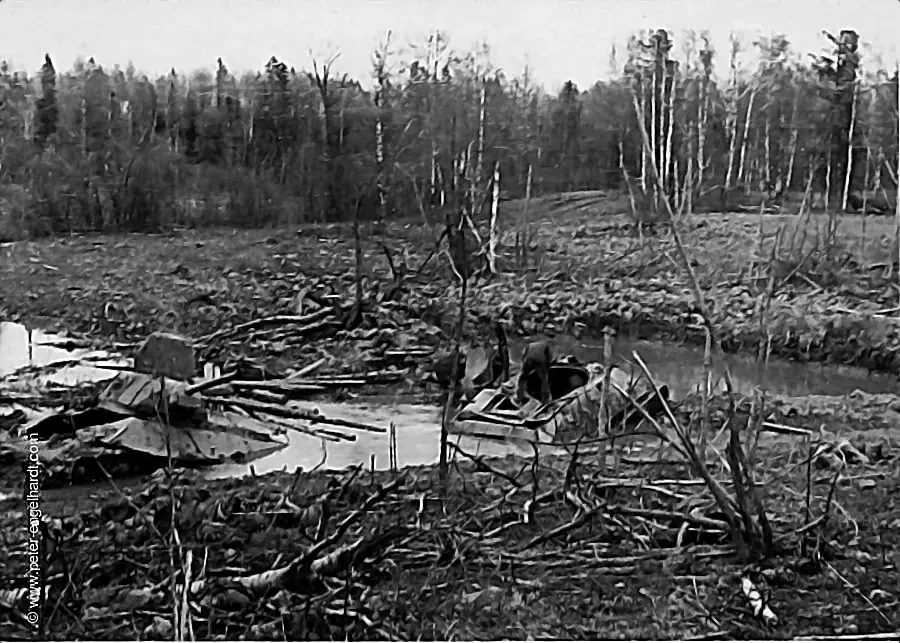
The devastating impact of dive-bombers. The novel coordination between Panzer divisions and Stuka squadrons (Junkers Ju 87) played a major role in the German success in France (and, to a lesser extent, in the initial success of Operation Barbarossa the previous year).
The image documents the devastating impact and strategic importance of dive-bombers during World War II. The novel coordination between Panzer divisions and Stuka squadrons (Junkers Ju 87) was instrumental to the success in France and also contributed significantly to the Wehrmacht’s tactical superiority at the start of Operation Barbarossa the previous year.
However, regarding military reality, the image also illustrates the limitations of this concept under extreme conditions, such as those prevailing in the Volkhov region. While the cooperation between the Luftwaffe and ground forces enabled highly dynamic successes during the early phase of the war, these tactical advantages lost their significance where terrain conditions—such as quagmires and impassable swamps—severely hampered the deployment of motorized units or, as seen here, brought the Panzer advance to a virtual standstill.
The visually distinct text was created in July 2026 with the help of the AI Gemini. - Page translated with Google.
© Peter Engelhardt, www.peter-engelhardt.com. All rights reserved.


