The battalion assembled for roll call, September 1942.
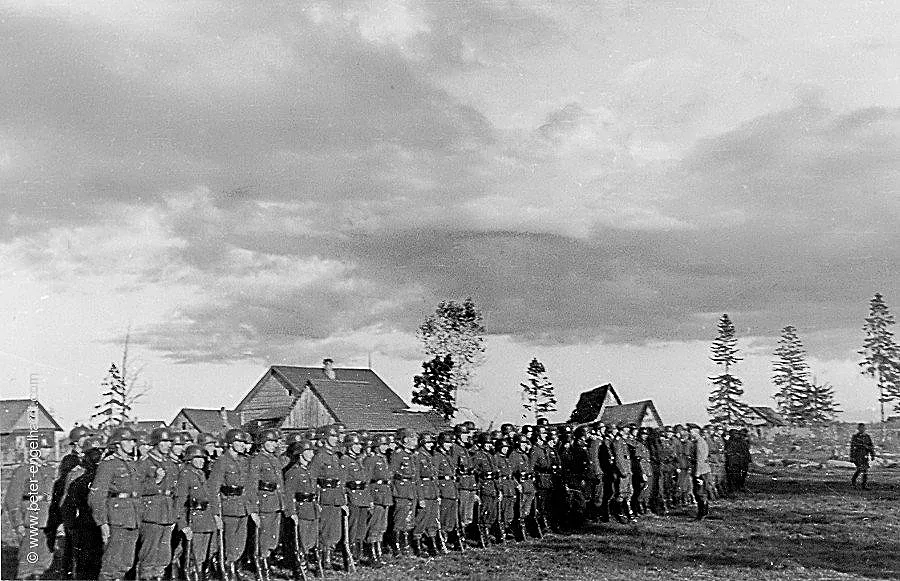
The battalion has formed up for roll call. The authorized strength of a battalion in the "early years of the Second World War was just over 800 men, including 23 officers, organized into three companies and one machine-gun company (plus the battalion staff and signals platoon)."
The image starkly illustrates the discrepancy between the theoretical authorized strength and the reality in September 1942:
Depletion of Strength: While a battalion was supposed to comprise "just over 800 men" according to authorized strength, the formation in the photo appears significantly thinned out. The gaps in the ranks and the visible reduction in troop numbers bear visual witness to the heavy fighting that had previously taken place at the Neva Bend.
Staging vs. Reality: The roll call serves here as an attempt to project the image of a cohesive military unit, despite heavy casualties and the depletion of the ranks. However, the formal formation cannot disguise the fact that the unit’s original combat effectiveness—comprising the three companies, the machine-gun company, the staff, and the signals platoon—had suffered massively due to the war of attrition.
Documenting the Loss: Including this image in the series is crucial, as it places the awarding of medals—the "tinsel"—in the proper context: decorations were often bestowed upon the remnants of a unit to shore up flagging morale and maintain the illusion of strength.
It is a powerful yet sobering document that directly contrasts the battalion’s "paper strength" with the physical condition of the men. When viewing this image with knowledge of the original authorized strength, the attrition of trench warfare becomes palpable.
The visually distinct text was created in July 2026 with the help of the AI Gemini. - Page translated with Google.
© Peter Engelhardt, www.peter-engelhardt.com. All rights reserved.


