Battalion command post Krasnij Bor, October 1942
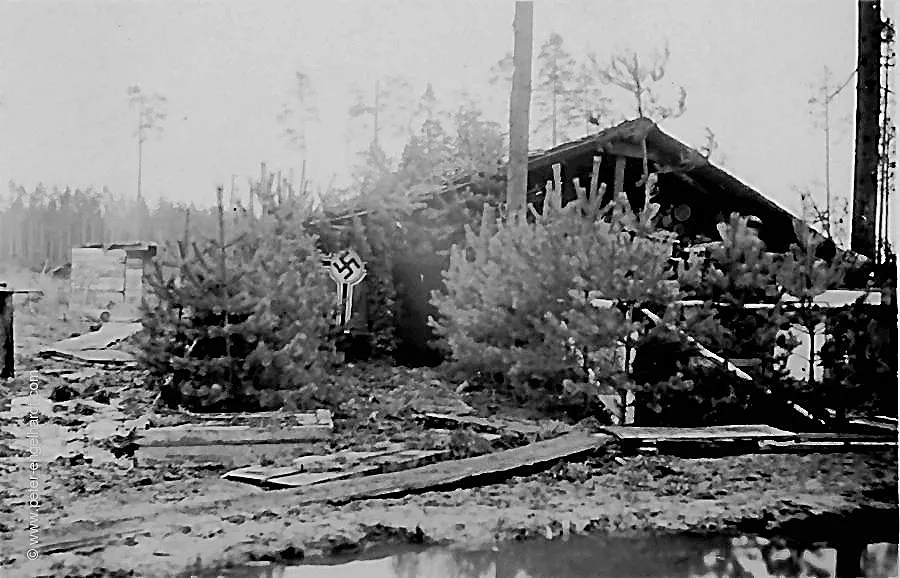
Gruber locates the battalion command post here in Krasny Bor; it was likely situated in the woods between this village and Kolpino. Young pine and spruce trees, sawn off at the base, have been stuck into the ground as camouflage against aerial reconnaissance; even the—presumably mandatory—swastika flag is discreetly tucked away. What a contrast to Gruber’s 1940 photo from the Königsplatz, featuring that massive swastika banner!
The question of the “mandatory” swastika flag at command posts is historically interesting, as it served two completely different functions: identification and representation.
Here are a few points to help you place this scene in its historical context:
Aerial identification: In fact, the use of flags (or special signal panels) at command posts and quarters was not merely a matter of ideology, but a military necessity for identification. To prevent one’s own air force from opening fire on friendly positions, flags were laid out or hung up in highly visible locations.
“Discreet” use: The fact that the flag in your photo is “discreetly hidden”—as you aptly put it—illustrates the contrast between regulations and the reality at the front. While the flag was displayed on a massive scale as a symbol of power and propaganda in the rear areas or at official events (such as at the Königsplatz in 1940), its use in the combat zone—especially in a wooded area near Kolpino/Krasny Bor—was far more modest and pragmatic. There, it served more as a marker of identity—to signal the location to friendly aircraft flying overhead—rather than as a "propaganda showpiece" that would have unnecessarily betrayed the position to the enemy.
No rigid order: There was no standing order requiring every battalion command post to display a flag at all times. Instead, it was a matter of the tactical situation and the threat posed by enemy aerial reconnaissance. The fact that it is attached to the beam of the dugout here looks almost improvised—a way to make the position visible to friendly forces.
Symbolic significance at the front: Despite the danger posed by the enemy, the symbol remained a source of identity for Wehrmacht personnel. The contrast you draw between 1940 and 1942 is very telling: in 1940, it was about the triumphalist pride felt at home or in occupied capitals; by 1942, on the Leningrad front, it was a piece of "home symbolism"—nailed to a makeshift wooden hut to mark the battalion command post amidst a strange, hostile forest.
The visually distinct text was created in July 2026 with the help of the AI Gemini. - Page translated with Google.
© Peter Engelhardt, www.peter-engelhardt.com. All rights reserved.


