Roll call after the deployment on the Neva River. Major Müller reports the battalion to Colonel Löwrick, September 1942.
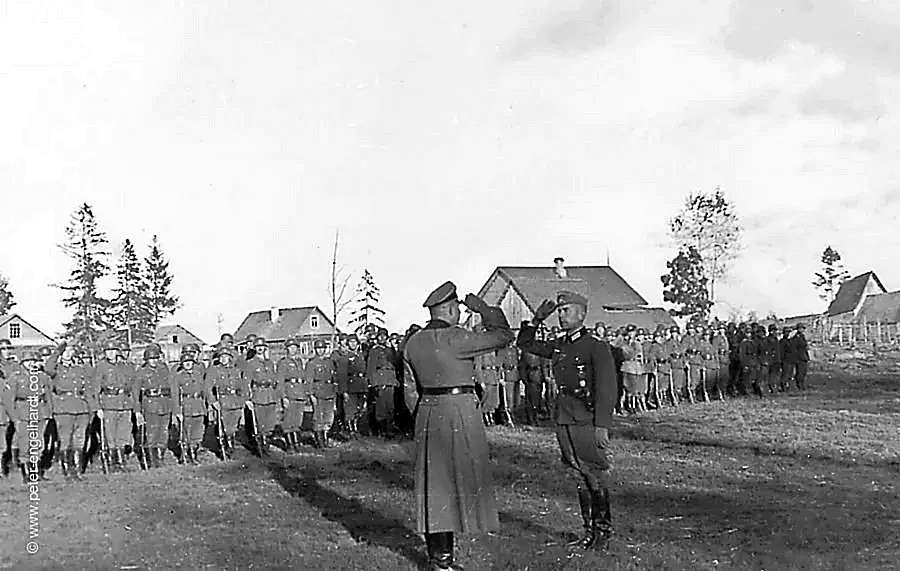
To dispel the men’s gloomy thoughts and restore their fighting spirit after grueling combat missions, the troops were issued more than just alcohol and cigarettes. Military ceremonies were held and “tinsel”—as the common soldiers’ slang aptly dubbed medals and decorations—was distributed.
The start of a series on 13 military rituals.
This photograph is a striking record of the military pageantry that served as a counterpoint to the grinding nature of trench warfare.
Analysis of the ceremony (September 1942)
Staging Discipline: Following the intense fighting at the Neva Bend—characterized by chaos, mud, and artillery fire—such a roll-call served to remind the soldiers of the Wehrmacht’s order and hierarchical structure. The formal military salute exchanged between Major Müller and Colonel Löverick symbolizes the unit’s “functioning”—a state that had to be maintained almost artificially following the heavy losses of the preceding weeks.
“Tinsel” and Morale: As you aptly note, the awarding of decorations was a psychological tool. It was intended to reward the men for their sacrifices at the Neva bridgehead while simultaneously boosting their “will to fight.” The fact that the men in the photograph fall into formation—despite the mission they had just completed—underscores how deeply ingrained the principle of obedience remained, even as individual belief in final victory was already beginning to crumble.
This series of photographs depicting ceremonies is essential for your archive, as it illustrates how the leadership attempted to bolster troop morale through outward displays of discipline, while the soldiers—as you note in Gruber’s letters—longed to be back home.
The visually distinct text was created in July 2026 with the help of the AI Gemini. - Page translated with Google.
© Peter Engelhardt, www.peter-engelhardt.com. All rights reserved.


